Chapter 02. The institutional economics toolkit

This is the June 2026 draft of chapter 02 in my forthcoming new book, When Policy Falls Behind: Bitcoin, AI, and the Governance of Fast Systems. Comments are welcome!
Introduction
Bitcoin – a decentralized, permissionless, peer-to-peer protocol (Nakamoto, 2008) – is often introduced through monetary economics, computer science, or political theory (Antonopoulos, 2015; Böhme et al., 2015; Narayanan et al., 2016; Ammous, 2018). Monetary scarcity, distributed consensus, censorship resistance, self-custody, and the possibility of exit from the traditional monetary system are features that distinguish Bitcoin from traditional forms of money and commodities. Bitcoin governance disputes still arise, however, because a technical system that settles operational functions by mathematical rule produces social questions that those rules alone cannot settle.
My institutional perspective on Bitcoin begins from that gap: it treats firms, markets, legal systems, and the protocol itself as rule-structured arrangements rather than as neutral backgrounds for economic action. For example, a Bitcoin transaction can be valid under consensus rules even when its broader legal or custodial status remains contested. A mining facility can satisfy local electricity market requirements yet face doubt about whether PoW validation, which consumes energy to secure the blockchain, is a legitimate use for energy infrastructure that could heat homes and power industry. A custody arrangement can lower operational burdens for institutional Bitcoin holders and, in the same move, weaken their practical agency inside Bitcoin governance.
Bitcoin's institutional properties sit within the rapidly accelerating technological environment around it. Institutional latency is the label I use to describe the lag between new information emerging and a binding institutional response that addresses the policy challenge at hand. Institutional latency appears when an available governance form is poorly matched to the nature of the transaction it seeks to govern, and often persists when actors cannot settle what they have reason to want from the system itself.
In chapter 2, I assemble a theory-based toolkit (Table 2.1) that draws heavily from the Nobel lineage of institutional economics – Coase, North, Williamson, and Ostrom – together with Bromley's (2006) volitional pragmatism and an adaptation of Hirschman's (1970) voice and exit distinction. New Institutional Economics (NIE), associated with Coase (1937, 1960), North (1990, 1991, 2005), and Williamson (1979, 1985, 2010), supplies the structural apparatus for evaluating institutional latency: transaction costs; institutional boundaries; governance form selection; credible commitments; and path dependence. The Old Institutional Economics (Veblen, 1898; Rutherford, 1996; Hodgson, 1998), the Ostromian commons traditions (Ostrom, 1990; Ostrom and Ostrom, 2004; Ostrom, 2005), and American Pragmatism (Dewey, 1938; James, 1978; Peirce, 1997 (1877); Bromley, 2006), explain why habits, norms, intelligent inquiry, collective action, and contested purposes shape the response.
Table 2.1. Institutional economics toolkit
| Source | Concept | Diagnostic question | Bitcoin application |
|---|---|---|---|
| North | Formal rules, informal norms, and path dependence | Which expectations are sticky and why are they difficult to revise? | Consensus rules, governance norms, legitimacy judgments, and persistent disputes over Bitcoin’s purpose |
| Coase | Transaction costs and institutional boundaries | Where are costs being reduced, shifted, or made harder to observe? | Self-custody versus institutional custody; Bitcoin versus issuer-based payment instruments |
| Williamson | Governance form fit, asset specificity, uncertainty, and frequency | Does the economic transaction fit the available governance form? | Mining host relationships, custody dependence, and quantum migration under an external deadline |
| Ostrom | Action arenas and institutional levels | At what level does the dispute occur? | Operational validation, implementation practice, political standing, and epistemic commitments |
| Bromley | Volitional pragmatism and intelligent inquiry under indeterminacy | Is the problem calculation within given objectives, or inquiry into what there is reason to most want? | Disputes over the purpose of monetary scarcity, nonmonetary data use, energy legitimacy, and post-quantum intervention |
| Hirschman | Voice and exit, adapted to permissionless governance | What can dissatisfied actors actually do? | Self-custody, institutional recourse, software choice, forks, and exit from governed interfaces |
Coase explains why informal commitments are harder to revise than formal rules. Williamson covers why different transactions select for different governance forms. Elinor and Vincent Ostrom locate contestation and cooperation across operational, collective choice, constitutional, and meta-constitutional levels. Bromley's volitional take on pragmatism explains why many institutional conflicts are failures of collective inquiry rather than of computation. Hirschman's voice and exit, adapted to Bitcoin's permissionless system, identifies what users can actually do when an arrangement fails to meet their aspirations. Together these tools identify where friction appears, why it persists, and which institutional capacities would be required to manage it.
Institutional economics theory and application
Douglass North: rules, norms, and path dependence
Institutions as expectations
North's (1990) institutional economics begins with a deceptively simple claim: institutions are the “rules of the game.” That phrase, however, obscures North's deeper contribution, which is that institutions structure expectations. They inform actors about which commitments are credible, which violations will be punished, and which conflicts can be handled locally without revisiting underlying higher-level commitments. Institutions reduce uncertainty by making other actors' behavior more predictable (North, 1991; Ostrom, 1998), which enables forward thinking about longer time horizons (Fishburn and Rubinstein, 1982; Frederick et al., 2002). This helps lower the effective discount rates applied to societal investments that shape collective futures but can also create inertia, because the same expectations that make social action possible then become costly to revise once actors have organized around them – the condition of path dependence (Arthur, 1989; North, 1991; Pierson, 2000).
Formal rules and informal norms
North (1990, 1991) first separates formal rules from informal social norms. Formal rules include statutes, regulations, constitutions, property rights, contracts, agency procedures, and written standards; they are visible, amendable, and normally attached to identifiable authorities. Informal norms include conventions, habits, professional expectations, legitimacy judgments, and shared understandings about acceptable conduct (Meyer and Rowan, 1977). Norms may be even stronger than formal rules precisely because participants recognize their legitimacy and experience them as “common sense” rather than as rules at all (Ostrom, 1990, 2000; Berger and Luckmann, 2016). A formal rule transparently announces itself as an “institutional object” (Searle, 2005); a norm is stealthy, often becoming visible only after someone violates it.
Norms and institutional latency
Formal rules can be revised through legislation, regulation, judicial interpretation, contract amendment, or administrative procedure. These processes are often slow, contested, and politically costly (Mahoney and Thelen, 2010), yet they provide recognized mechanisms for deliberate change. Informal norms have no equivalent switch. A community can debate them, challenge them, or gradually stop relying on them, but it cannot conjure new norms into existence simply because conditions have changed. A norm must lose authority, be reinterpreted, or be displaced by a rival practice that enough participants come to treat as legitimate (Knight and Ensminger, 1998; Ostrom, 2000). Subtle value-oriented nudges are often the only policy tool available to facilitate that slow process (Thaler and Sunstein, 2008).
Path dependence
North’s concept of path dependence explains why this asymmetry has lasting force. Institutions do not begin each period from a blank slate (North, 1991, 2005). Actors invest in the existing order by learning its rules, building organizations around it, acquiring assets suited to it, developing reputations within it, and forming expectations about how others will behave. Those investments, as Brian Arthur (1989) demonstrated, generate increasing returns. The more participants coordinate around a rule or norm, the more valuable the shared settlement becomes and the more expensive deviation becomes. A path-dependent institution can therefore persist after the conditions that originally justified it have weakened because abandoning it would require collective movement to an alternative that participants may not yet trust.
Institutional persistence under these conditions is not irrational but is often a reasonable response to coordination costs. A norm that has accumulated cultural trust functions as a public asset (e.g., Greif, 1994) even when its substantive content is disputed. Participants may defend it because they value the stability it provides, fear opportunistic use of reform, or cannot distinguish a needed update from an attack on the institution itself. Many Bitcoin disputes concern whether a proposed code upgrade preserves the institution or begins to alter the basis on which participants trusted it (De Filippi and Loveluck, 2016; Bier, 2021). Differences in opinion among epistemic communities (Haas, 1992) within the policy world, industry, and academia produce the advocacy coalitions and instrument constituencies that form around competing norms and advocate for particular policy solutions (Sabatier, 2007; Mintrom and Norman, 2009; Howlett et al., 2017).
Norms in the Bitcoin space
Bitcoin makes the formal/informal distinction clear because its operational layer is highly formalized (Nakamoto, 2008) but its higher-level governance remains heavily normative. Algorithmic consensus rules determine whether a transaction or block is valid and a node either accepts or rejects what it receives. That operational clarity can make Bitcoin appear institutionally simple but most disputes that matter for governance do not stay at the operational layer. Relay policy, software release norms, activation practices, miner signaling, exchange behavior, custody standards, and community judgments about legitimate use all depend on conventions maintained outside the consensus mechanism. They are still institutional though, even when not formally written down.
The Core v30 and Knots implementation dispute illustrates the point (see Chapter 3). The controversy over OP_RETURN relay policy in the Bitcoin Core v30 upgrade is formally about transaction relay defaults but the intensity of the disagreement originates in higher-level commitments about what Bitcoin should be for. Bitcoin Core advocates interpret permissive relay policy as neutrality toward valid transactions. Knots advocates interpret the same policy as a weakening of Bitcoin's monetary purpose through avoidable non-monetary use of block space (“spam” from the Knots perspective). Arguments about the technicalities of the code do not settle the dispute because the relevant question concerns what implementation norms around valid transactions should express: a monetary-only conception of Bitcoin or a broader settlement-neutral conception. Epistemic questions about what Bitcoin is best used for cannot be answered simply by deferring to its consensus code.
Energy governance shows the same mechanism at the boundary between Bitcoin and public institutions (Chapter 4). A Bitcoin mining facility – a specialized data center – may satisfy interconnection rules, pay market electricity rates, and provide flexible load services to the local grid. Mining technology and its quantifiable impacts do not, however, settle whether regulators or citizens regard PoW as a legitimate claim on energy infrastructure. The unresolved issue lies in the value filter through which energy demand is interpreted. Where a jurisdiction treats energy use as legitimate only when it produces recognizable and positive local impact, PoW can remain contested even after a mine’s operational facts are settled because the relevant social norms concern purpose rather than measurement (Miles, 2018; Brown, 2025).
Custody presents a third version of the same problem (Chapter 5). Self-custody and institutional custody locate the holder inside different institutional orders. Self-custody places responsibility, verification, and exit capacity with the user (Antonopoulos, 2015). Institutional custody places key control inside regulated organizations (Zetzsche and Nikolakopoulou, 2025) that supply convenience, compliance, reporting, and recourse. As institutional custody grows, practices that began as optional accommodations can become expectations. Fiduciary norms, audit standards, compliance workflows, and board procedures – the tools of financialization – then make institutional custody appear natural for large holders even where direct control remains technically available. That is path dependence operating through professional legitimacy.
Algorithmic systems generate new conditions quickly and formal rules may eventually adapt to them, but informal norms carry the deeper epistemic settlement about what conduct is legitimate. Because those norms are embedded in expectations, identities, organizational routines, and accumulated trust, they change slowly and unevenly. Enduring institutional latency thus appears when technical changes require a community to revise the background commitments that made the existing institutional object intelligible. Bitcoin's governance disputes, energy conflicts, custody shifts, and protocol stress tests all center on that problem: computer code can define transaction validity but institutions define what validity is supposed to serve.
Ronald Coase: transaction costs and institutional boundaries
The boundary question
Ronald Coase (1937) began with a question that appears ordinary but reorganizes the study of institutions: why are some activities coordinated through markets while others are organized inside firms, governed through contracts, or managed by public agencies? Transaction costs supply the answer because they extend analysis beyond the internal financial costs of producing a good or service. Exchange is not costless because actors must find one another, define the object of exchange, measure quality, negotiate terms, monitor performance, enforce obligations, and manage disputes. Where transaction costs are low, market exchange can coordinate activity effectively. Where they are high, however, other forms of organization economize on transaction costs and become attractive.
The boundary between markets and organizations is not fixed but moves as technologies, legal rules, asset characteristics, and participant capacities change. A function that once required internal hierarchy can move into the market once measurement becomes easier or contracting becomes more reliable. A function that once worked through market exchange can move into hierarchy or regulation as dependence, uncertainty, and enforcement problems grow, or as externalities manifest. Coase's (1960) point is not that firms are better than markets or that markets better than firms; the comparison is dynamic, and actors experiment with the institutional arrangements until they find those that minimize the transaction costs they face.
Extending Coase beyond the firm
The Coasean logic also applies beyond the firm (e.g., Hart et al., 1997; Birner and Wittmer, 2004). Public agencies, courts, standards organizations, professional communities, open-source projects, and protocol networks all exist because some transactions cannot be handled cheaply through spot exchange alone. Regulation can pre-emptively clarify obligations before conflict arises; professional norms can make conduct predictable without constant enforcement; and algorithmic protocol rules can replace discretionary verification with automated validation. Each arrangement economizes on one set of transasction costs while creating another.
Bitcoin's protocol rules lower the cost of financial settlement by allowing users to verify ownership transfer without a trusted intermediary (De Filippi and Wright, 2018), but this achievement relocates transaction costs rather than eliminating them. Users who hold keys directly avoid issuer and custodian dependence while assuming the risk of error recovery and theft protection, and the costs of storage and tax reporting. Users who rely on professional custodians reduce their operational costs but accept counterparty risk and weaker practical agency in Bitcoin governance. The boundary between self-custody and institutional custody is a shifting transaction cost boundary, not a moral dividing line.
Boundary movement in Bitcoin
The custody boundary (Chapter 5) is the mechanism through which Bitcoin is financialized – drawn into the traditional financial world (Chen et al., 2025; Mazur and Polyzos, 2025). When self-custody is too risky or costly for an investor, institutional custody can become the preferred solution. Once that choice is made at scale, surrounding institutions adapt. Custodians, insurers, lenders, regulators, and auditors build routines around the new arrangement. Those routines lower the cost of remaining inside institutional custody and raise the cost of moving back toward self-custody. Boundary movements therefore create path dependence rather than just reflecting preference.
A payment stablecoin (Chapter 9) is just a private issuer’s promise whose credibility depends on reserve quality, redemption capacity, compliance, and failure treatment (Ahmed et al., 2025; Aronoff et al., 2026; Perritt Jr., 2026). The relevant transaction cost is credible recourse: users need confidence that the issuer can maintain par value, process redemptions, manage reserves, and survive stress. That structure invites a governance form built around supervised intermediaries.
Bitcoin self-custody, on the other hand, does not create the same institutional object because no issuer promise exists to supervise (Narayanan et al., 2016). Public law can regulate custodians, tax treatment, fraud, and illicit finance around Bitcoin, but it cannot transform Bitcoin into an issuer-based payment instrument. The contrast delineates what Bitcoin's exit option actually offers: movement to a different kind of institutional object whose governance burdens fall on the user rather than on a supervised intermediary.
Protocol governance presents another boundary. Bitcoin’s code can settle operational validity but cannot settle every question about what the protocol should become. The boundary between code and community appears whenever a technically possible change requires interpretation of Bitcoin’s purpose. Soft fork activation, relay policy defaults, post-quantum migration, and disputes over using Bitcoin for non-monetary data all occupy that boundary. Treating these as purely technical problems hides the transaction costs of coordination, legitimacy, and dispute resolution that appear once implementation choices touch political or epistemic commitments (Bier, 2021).
Evolving governance cost
When transaction costs change, the institutional boundary should move with them. Institutional latency appears when the existing boundary is sticky, misdrawn, or defended by actors whose investments depend on it. A custody arrangement may persist because fiduciary procedures and compliance routines have adapted to it. A regulatory category may persist because agencies, courts, and firms have built expectations around it.
Rather than asking whether a technology should be governed by markets or subject to more regulation, the analytical choice should be to ask which costs the current arrangement reduces, which costs it shifts elsewhere, and which actors bear the residual burden. That question makes institutional boundaries observable and also prevents a common error in Bitcoin analysis, assuming that disintermediation eliminates governance costs. Bitcoin removes the need for some formal intermediaries but the institutional work of custody, interpretation, and stress response remain with the holder.
Oliver Williamson: governance form selection
From transaction costs to governance forms
Oliver Williamson (1979, 1985, 2010) extended Coase’s boundary analysis by asking which kind of governance form fits which kind of transaction. He found that the answer depends on the attributes of the transaction itself. A routine purchase of a fungible (generic) good – one Bitcoin for example – can be governed by market exchange because parties can switch counterparties with minimal cost. A relationship involving specialized investment, uncertain performance, or repeated adjustment requires more protection: contractual safeguards; relational governance; hierarchy; or deliberative arrangements capable of resolving disputes as circumstances change.
Three attributes carry most of the analytical weight in Williamson's framework. Asset specificity measures how much value an investment loses outside the relationship for which it was made. Uncertainty measures how difficult it is to anticipate contingencies and verify performance. Frequency measures how often similar transactions recur. Together these attributes determine whether market exit is cheap, whether bargaining can be repeated, and whether parties can justify investing in governance capacity.
Matching transaction types and governance forms
The discriminating alignment hypothesis states Williamson’s (1985) core claim: transactions should be matched with governance structures that minimize transaction costs. Low specificity and low uncertainty favor market governance. Higher specificity and uncertainty favor hybrid or relational arrangements. Extreme specificity and uncertainty may require hierarchy, strong deliberative capacity, and formal dispute resolution. His framework is not a moral theory of centralization but an economic theory of governance fit.
Bitcoin's high-level disputes typically display the attribute configuration that Williamson's framework predicts would require intensive hierarchical governance. Specificity is high because many participants have a deep history and accumulated trust around particular meanings of Bitcoin, and reorganization around alternative meanings would forfeit that commitment. Uncertainty is high because the consequences of changing those meanings are difficult to measure in advance: any settlement of what Bitcoin is for shapes outcomes that cannot be tested against a counterfactual. Frequency is low because major questions about protocol identity or monetary purpose do not recur in stable enough forms to support repeated learning.
The discriminating alignment hypothesis predicts that transactions with this configuration require hybrid or hierarchical governance, an architecture that Bitcoin by design cannot supply (Nakamoto, 2008; Antonopoulos, 2015; Narayanan et al., 2016). The protocol is built around consensus rules that bind all participants symmetrically, with no formal authority empowered to resolve disputes that the consensus mechanism itself cannot settle. The governance form the transaction requires is structurally unavailable, and that unavailability – dating back to Bitcoin's cypherpunk origins (Brunton, 2019; Jarvis, 2022; Nabben, 2023) – is constitutive of its institutional identity rather than a deficiency to be corrected.
Credible commitment and the fundamental transformation in Bitcoin
Credible commitments reduce transaction costs by making promises – and threats – believable (Williamson, 1983). In conventional settings, commitments are supplied by collateral, reputation, contract law, repeated dealing, or regulation. Bitcoin supplies a distinctive operational commitment through the PoW mining process (Berg et al., 2020; Treiblmaier, 2023). Miners expend energy and capital in ways that are observable and costly to reverse, a thermodynamic commitment (Chapter 4). The expenditure makes it prohibitively expensive – requiring implausibly high levels of compute infrastructure and energy – to retroactively alter transactions in the blockchain, and it gives the global, decentralized ledger its hardened security (Narayanan et al., 2016). The process manufactures confidence in a novel way, creating a “trust machine” (Berg et al., 2020; De Filippi et al., 2020) that was unavailable at any time before Bitcoin’s invention.
The same commitment machinery, however, faces a challenge. A miner’s investment in Bitcoin-only application-specific integrated circuit (ASIC) hardware creates high asset specificity. A mining facility’s interconnection agreement, power contract, and local permitting relationships create further dependence on host jurisdictions. Once those investments are made, the relationship changes. What looked competitive before investment becomes bilateral dependence after investment. Williamson called this the “fundamental transformation” (Williamson, 1985): parties can no longer rely on simple market exit because each has made investments whose value depends on the relationship continuing.
Custody exhibits a different form of the same transformation (Chapter 5). Before institutional Bitcoin products are launched, custodians compete for mandates. After launch, issuer filings, audit procedures, creation and redemption workflows, compliance approvals, and operational integrations make switching costly. The custodian and fund issuer become locked into a relationship that market competition no longer disciplines in the same way. Concentration matters but the deeper governance problem is the bilateral dependence created once relationship-specific investments have been made.
Governance form mismatch and institutional latency
Governance form mismatch appears when a transaction demands a form of governance the institutional setting cannot supply (Table 2.2). Bitcoin handles routine operational transactions well because the protocol supplies validation without deliberation. It handles additive technical change tolerably when participants can review, test, signal, and adopt on a flexible timeline. It handles political and epistemic coordination poorly when the dispute requires binding collective judgment under uncertainty.
Table 2.2. Governance form mismatch in Bitcoin
| Transaction condition | Governance need | Bitcoin strength | Bitcoin vulnerability |
|---|---|---|---|
| Routine operational validation | Rule execution without discretionary judgment | Consensus rules make validity cheap to verify and difficult to override | None to date; potential for quantum computing attacks in the future |
| Additive endogenous protocol change | Review, testing, legitimacy, signaling, and adoption | Open review and opt in adoption can support careful change on a flexible timeline | The process remains slow and depends on informal authority rather than binding collective decision |
| Political or epistemic dispute | Collective judgment about standing, authority, and what Bitcoin is for | Exit constrains coercive change and makes capture harder | Formal voice is weak, so disagreement can persist without institutional settlement |
| External deadline or exogenous threat | Binding coordination before the response window closes | Resistance to imposed change protects monetary commitments and user autonomy | The architecture that resists coercion can produce latency when defensive coordination becomes necessary |
Quantum migration provides the clearest stress test (Chapter 6). Adding an optional post-quantum output type to Bitcoin's code, BIP 360 (Beast et al., 2024), involves non-controversial operational-level change. Freezing unmigrated legacy coins, BIP 361 (Lopp et al., 2026), would instead force an epistemic judgment about property rights and justifiable confiscation. Williamson's framework specifies the structural context of BIP 361: high specificity; high uncertainty; low frequency; and no hierarchical governance mechanism. Severe institutional latency is the predicted result because the governance form that the transaction demands is unavailable in Bitcoin. To change that would comprome Bitcoin’s non-hierarchical architecture and the philosophical commitments that many participants consider fundamental to the protocol's value.
The same framework clarifies why financialization-oriented and sovereignty-oriented participants reach different conclusions about Bitcoin's institutional development. Financialization-oriented actors treat hierarchy, supervision, attestation, and institutional custody as transaction-cost-reducing because they lower uncertainty and supply recourse. Sovereignty-oriented actors treat the same arrangements as relationship-specific dependencies that recreate the very hazards Bitcoin was meant to avoid. The cleavage is central to the debate over how, when, and why Bitcoin should be financialized rather than positioned as a tool for exit from the dominant monetary system (Antonopoulos, 2015; Ammous, 2018; Yokoyama, 2022). Williamson’s framework specifies what each arrangement economizes on, what it exposes users to, and where mismatch is likely to surface under stress.
The Ostroms: Institutional Analysis & Development (IAD) framework
From rules to arenas
The Institutional Analysis and Development (IAD) framework was developed by Elinor and Vincent Ostrom (Ostrom, 1990; Ostrom and Ostrom, 2004; Ostrom, 2005), and locates institutional action in settings called action arenas. In an action arena, actors occupy positions, make choices, use information, face rules, and generate outcomes that participants and affected communities evaluate. The de facto rules in use that structure these arenas include written rules, informal social norms, and shared expectations that shape what actors can do given their resource constraints and aspirations.
Note that in this book I use non-technical terminology – implementation, political, and epistemic levels (Rudd, 2010) – in place of the original IAD labels of collective-action, constitutional, and meta-constitutional (McGinnis, 2011). The epistemic level recovers Vincent Ostrom’s (1982, 1997) meta-constitutional concern with shared values and worldviews, which empirical IAD analyses tend to miss.
Operational and implementation levels
The operational level is where direct action occurs under existing rules. In Bitcoin, this includes transaction signing, validation, mining, relay, and settlement. Operational rules are precise because code enforces them: a transaction is either valid under consensus rules or it is not (Nakamoto, 2008). That precision lowers the cost of verification and eliminates dependence on discretionary authority (Lustig and Nardi, 2015; Berg et al., 2020; De Filippi et al., 2020). Disputes properly addressed at this level concern whether existing rules have been followed, not whether the rules themselves are correct. Operational-level institutional latency is therefore rare: the level executes at protocol speed and questions that arrive here are either resolved by algorithmic rules or recognized as belonging at a higher level.
The implementation level governs how operational rules are made, interpreted, and revised. In Bitcoin, this includes the BIP process[1], client releases, soft fork activation practices, miner signaling conventions, and community expectations about responsible software maintenance. The implementation level is less formal than the operational layer and depends on reputation, expertise, and review norms. Disputes properly addressed at this level concern how to specify, test, and adopt rule changes. Implementation-level institutional latency takes the form of legitimacy lag: a technical change is possible and the operational layer can absorb it, but the implementation conventions that authorize and coordinate the change have not yet adjusted.
Political and epistemic levels
The political level concerns who has standing to authorize and shape lower-level implementation rules. Bitcoin has no formal membership body that assigns votes in proportion to ownership, node operation, development contribution, or mining power. Political standing emerges through technical competence, economic weight, narrative authority, infrastructure control, and credible threats of willingness to exit. This structure makes Bitcoin resistant to capture by any single formal hierarchy but it makes coordinated collective voice difficult whenever the system must settle a contested decision. Disputes properly addressed at this level concern who has standing to decide, not what specific rules should be implemented. Political-level institutional latency manifests as a structural asymmetry: strong refusal capacity combined with weak coordination capacity.
The epistemic level, the deepest layer, concerns the value filter through which lower-level rules are crafted and interpreted. What are actors’ aspirations regarding Bitcoin: peer-to-peer cash; digital store-of-value; censorship-resistant data settlement; or monetary exit? Different answers express more than preferences because they change how participants interpret proposals that rely on the same technological underpinning. A relay policy change, custody arrangement, or quantum migration plan can look prudent from one epistemic position and illegitimate from another. Disputes properly addressed at this level concern what Bitcoin should be for, not what it is or what rules govern it. Epistemic-level institutional latency is the slowest and most durable because shared values resist deliberate redesign (Denzau and North, 1994).
Cross-level dynamics
The four levels are nested (Figure 2.1) but not mechanically hierarchical (Ostrom, 2005). Epistemic commitments shape political standing. Political arrangements shape implementation by choosing who designs the rules and by directing resources that increase the likelihood of outcomes supporting specific epistemic positions. Implementation rules shape operational action by structuring incentives and by allocating resources to monitoring and enforcement. Operational feed back, often only weakly, upward by generating stress, surprise, or evidence that existing assumptions no longer hold. Institutional latency can originate at one level but manifest at another.
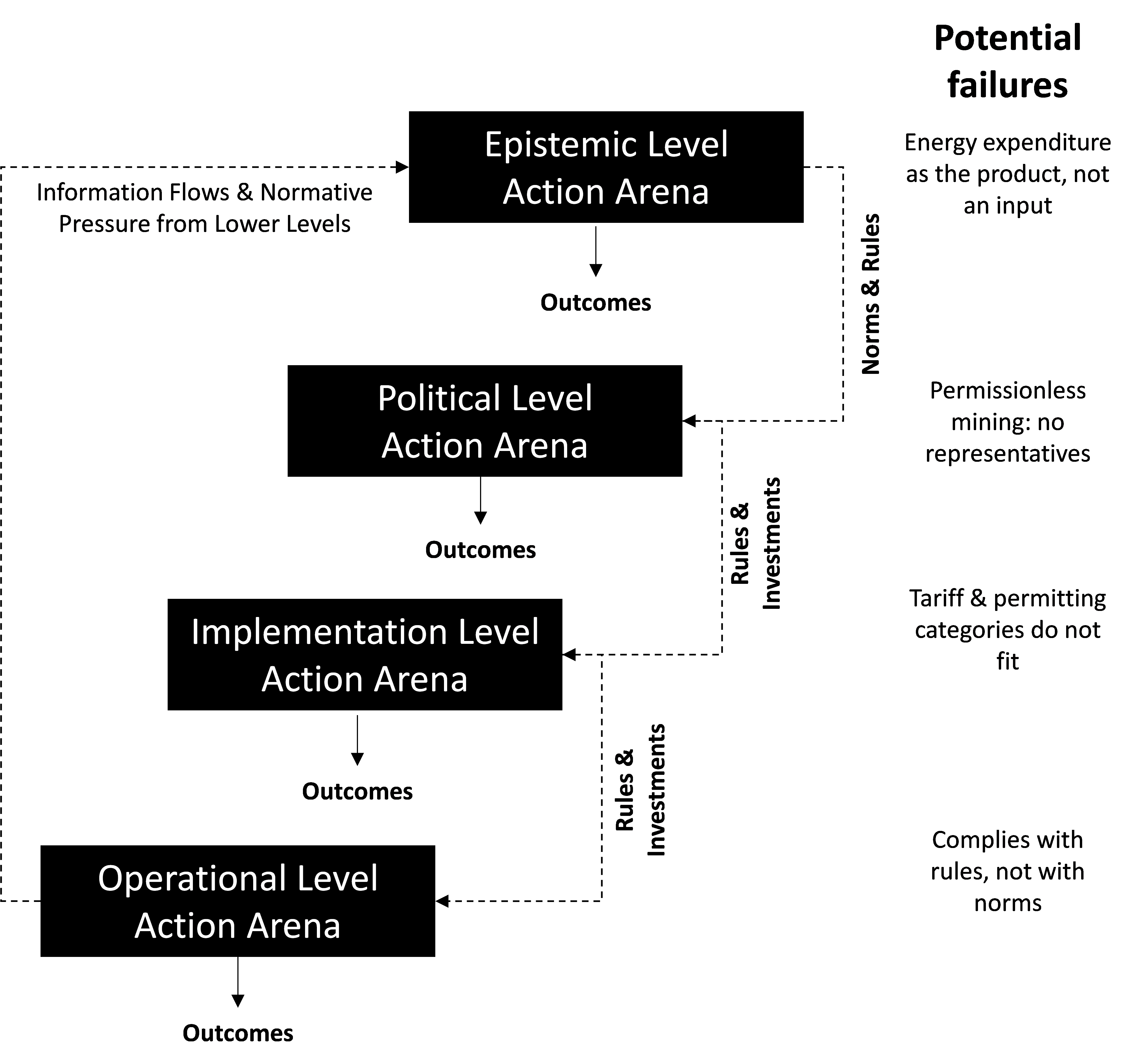
Bitcoin mining illustrates the cascade (see Chapter 4). Operationally, a mining facility may help balance grid load and pay market rates for electricity. At the implementation level, utility commissions and grid operators must decide how to classify and manage that demand. At the political level, public officials must decide whether the activity fits regional energy policy priorities. At the epistemic level, society must decide whether PoW produces social value recognizable enough to justify mining's energy claim. Conflict that appears as an operational dispute over interconnection terms may actually be an epistemic dispute about whether PoW is a legitimate use of energy infrastructure at all (Miles, 2018; Brown, 2025). Focusing analytical attention only on the operational level misses the level at which resistance is generated and at which it must be addressed.
The task for institutional analysis is therefore to locate the action arena, identify the level at which contestation is actually occurring, and ask whether the rules and norms at that level can supply the governance capacity the transaction requires. For Bitcoin, the consequential disputes usually involve level mismatch rather than ambiguity within a single level: a question that can only be answered at the epistemic level is argued as if it were operational, or an implementation question is treated as if it were political. Identifying the mismatch is the first analytical step toward diagnosing what kind of institutional response would be adequate.
American Pragmatism and the conditional register
Inquiry begins with surprise
American Pragmatism, developed by Peirce (1997 (1877)), James (1978), and Dewey (1938), locates inquiry as originating in the moment when settled belief encounters surprise. When the world behaves in ways existing habits do not explain, actors must move from routine action into reflective judgment. The result of inquiry is not final truth but provisional settlement good enough to make action possible under conditions that may change. Bromley’s (2006) volitional pragmatism extends this lineage into institutional economics.
Rapidly advancing technologies generate the kind of surprise that classical pragmatism identified as the occasion for inquiry (Rudd, 2023). Bitcoin made possible a monetary system with no issuer, no central balance sheet, a high level of security, and a fixed supply schedule enforced by protocol rules (Nakamoto, 2008) that together generate technology-based trust (Berg et al., 2020; De Filippi et al., 2020). AI systems rapidly generate new capabilities and ideas (Girotra et al., 2023; Aschenbrenner, 2024; Lu et al., 2024) before institutions can establish their governance structure. Stablecoins (Gorton and Zhang, 2023; Ahmed et al., 2025; Aronoff et al., 2026) make private dollar liabilities globally portable across digital infrastructures that do not map cleanly onto banking categories. Each development creates a need for intelligent inquiry (Dewey, 1927, 1938; Peirce, 1997 (1877)) rather than merely an engineering response.
Computational knowledge and volitional choice
Bromley (2006) distinguishes deterministic calculation toward a fixed objective function from volitional choice under indeterminacy, where actors must work out means and ends together. Deterministic calculation produces computational knowledge, which concerns how to achieve specified objectives; it is rule-following, model-based, and increasingly automatable through algorithmic technologies. Volitional situations are those in which the objective function itself is malleable and the question facing actors concerns what there is reason to want among the available options given their aspirations, assets, and environment (Rudd, 2000, 2004). Volitional choice requires – at least for now – human judgment about purposes, tradeoffs, legitimacy, and what there is most reason to want. Many institutional problems involve both registers, and confusion between them can itself be a source of institutional latency.
Bitcoin clearly displays the distinction sharply because the protocol can algorithmically validate signatures and blocks but cannot impose values about whether Bitcoin should maximize monetary purity, ensure settlement neutrality, or act as a tool to exit the current monetary system when epistemic commitments conflict. AI introduces a related problem: an algorithm may classify, predict, recommend, or generate at high speed but cannot determine, by computation alone, which use of that capability should count as acceptable social practice. The hard question is whether or not there is reason to want a technically feasible outcome.
Truth value and empirical discipline
Pragmatism commits the inquirer to fallibilism and to the discipline of holding beliefs accountable to experience. Peirce's (1997 (1877)) account of inquiry frames belief as a settled disposition arrived at through a self-correcting process that begins in genuine doubt and remains revisable under further evidence. James's (1978) radical empiricism extends this by insisting that what is admissible in philosophical argument must be drawable from – and testable against – lived experience. Haack (1976, 2003) sharpens the methodological consequence: genuine inquiry is distinguished from advocacy by its willingness to follow evidence wherever it leads and to abandon positions the evidence undermines. Claims should accordingly expose themselves to evidence: they should generate observable implications; identify the conditions under which they would fail; and remain open to revision when institutional facts change. In the Bitcoin context, the assertions I make in the later chapters should be treated as propositions with truth value under specific conditions, not as universal claims derived from first principles.
This stance separates pragmatist analysis from both deductive economic certainty, which is characteristic of praxeology in Austrian economics (Rothbard, 1977) and technological determinism (Smith and Marx, 1994; Wyatt, 2008), both of which treat outcomes as derivable from prior commitments rather than as contingent on conditions that can be empirically assessed. Bitcoin does not automatically produce sovereignty because users can hold keys; stablecoin regulation does not automatically produce stability because issuers can be supervised; and AI does not automatically improve governance because it increases computational knowledge. Each proposition depends on institutional and structural conditions: who controls the relevant interface; what costs users bear; which norms govern interpretation; what recourse exists under stress; and whether actors retain credible exit. These are not questions to be answered in the abstract but are the conditions under which propositions about Bitcoin hold or fail.
Theory does not replace empirical validation but instead identifies what to look for. North (1990) points to norms and path dependence. Coase (1937) points to moving boundaries. Williamson (1985, 2010) points to transaction attributes and governance form fit. The Ostrom’s (2004) point to levels and action arenas and Bromley (2006) to volitional inquiry. Together these traditions generate a disciplined set of questions rather than a closed doctrine. That is what makes institutional economics useful for a fast-moving technological environment: it organizes inquiry without pretending that inquiry has ended.
Albert Hirschman: voice and exit
Hirschman reinterpreted
Hirschman's (1970) distinction between “voice” and “exit” applies to Bitcoin only after slight adaptation. In his original formulation, voice is the attempt to repair or influence an organization from within, and exit is leaving the organization. Bitcoin, however, has no membership roll, board, or central administrator whose decisions bind everyone, so the standard entry and exit categories do not map cleanly onto its permissionless governance structure. Participants enter and leave through choices about how they use the protocol, what infrastructure they rely on, what custody arrangements they accept, and how they identify with Bitcoin's purposes. Voice and exit therefore operate through different institutional channels in Bitcoin than in the permissioned organizations Hirschman analyzed.
Voice in the adapted sense means recourse or effective participation in the governance arrangement on which a user depends. The traditional channels include complaint, legal claim, supervisory protection, and voting: any mechanism that can make an organization answerable. Exit means reduced dependence on organizations, which may take the form of withdrawing from a custodian, moving to self-custody, running different implementation software, and choosing direct peer-to-peer settlement. Exit is not absence of governance but movement from one type governance dependency to another.
Recourse and dependence
Institutionally custodied Bitcoin – an ETF or another Bitcoin wrapper – depends on an issuer promise and makes voice legible. That dependence creates an institutional object for which reserves can be audited, redemption can be regulated, compliance obligations can be attached, and failure can be administered. Users receive convenience, customer support, and legal recourse. On the other side of the tradeoff, they rely on the issuer's balance sheet, banking and exchange access, compliance judgments, and continuing permission to transact through supervised interfaces.
Bitcoin self-custody shifts the arrangement (Antonopoulos, 2015). The user gives up the recourse attached to intermediated finance and receives direct control over keys. This is exit in the adapted sense, with reduced dependence on issuers, custodians, and permissioned access points. This move from a financialization- to sovereignty-oriented institutional arrangement is not free. Users bear the personal burden of operational key management, security, estate planning, and tax compliance. The institutional question is not whether voice or exit is superior. It is which dependence a user is willing to accept and which risks that choice makes visible. That choice depends on the user’s values and on the structural conditions of the surrounding monetary and political system.
Permissionless governance
Bitcoin participation does not require formal authorization, so exit can be credible even without institutional permission. After memorizing a twelve-word seed phrase, a Bitcoin holder can exit a jurisdiction carrying their entire personal wealth in memory, something that has proven critical for citizens escaping conflict zones and predatory governance regimes (Gladstein, 2022). A user can run a node, refuse a software implemention they oppose, or transact globally without asking a custodian to update an internal ledger. That property – exit optionality – gives Bitcoin much of its institutional significance.
Boundary and position rules (Ostrom, 2005) exist for Bitcoin but are null, placing no restriction on who can hold Bitcoin or participate in its governance. The result is a recurring inversion between economic exposure and governance agency. Actors with large economic exposure may have weak governance agency when their exposure is held through custodians. Smaller self-custody users may have stronger implementation agency because they can run nodes, choose software, and coordinate exit (e.g., Atik and Gerro, 2018). Developers exercise technical influence without formal authority, miners can signal support for changes but cannot unilaterally redefine validity, and exchanges shape liquidity without settling legitimacy. Voice is thus distributed, uneven, and often informal, with no participant type holding the kind of integrated economic and governance position that membership-based organizations grant their members.
Voice, exit, and institutional latency
The balance between voice and exit shapes institutional latency. Where voice is strong, actors can deliberate, complain, seek recourse, and coordinate reform without abandoning the institution. Where exit is strong, actors can discipline organizations by reducing dependence. Where both are weak, lock-in appears. Where exit is strong but voice is weak, the system resists capture while struggling to coordinate constructive change. Bitcoin often occupies that last configuration, which connects the voice and exit framework to Williamson's (1985) account of governance form mismatch: Bitcoin's architecture supplies powerful exit but cannot supply the hierarchical or hybrid governance forms that would allow coordinated voice on contested questions.
Custody, energy, stablecoins, and quantum migration each reflect this balance. Institutional custody increases voice through legal recourse while weakening direct exit. Self-custody strengthens exit while limiting recourse. Energy governance gives public authorities strong voice over local infrastructure but gives miners geographic exit when relocation remains feasible. Quantum migration may require coordinated voice across the community, but the architecture's strongest binding mechanism remains exit. Hirschman's categories do not explain Bitcoin by themselves but they become useful once translated into the institutional dependencies that Bitcoin creates and paired with a specific governance form.
Velocity, latency, and timescale mismatch
Causal information chain
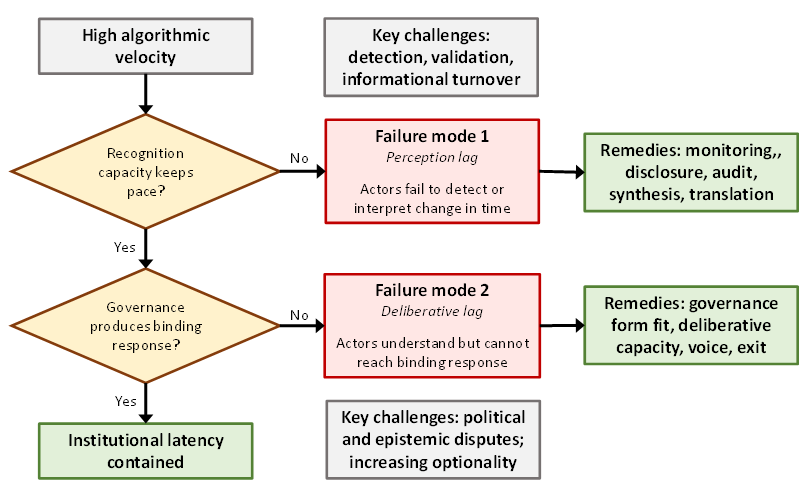
The central temporal problem in this book is not simply that technology moves faster than institutions. The problem is that different parts of the governance sequence move at different speeds and perform different institutional functions. “Algorithmic velocity” is the rate at which technical systems execute, adapt, discover, classify, deploy, or threaten. Bitcoin settlement, automated trading, AI outputs, and automated compliance screening all generate conditions faster than governance organizations can absorb.
I use the “recognition capacity” to label the first institutional constraint. It is the capacity to detect relevant change, validate the signal, interpret its meaning, and convert it into a claim that slower institutions can judge. Governance systems can automate parts of that work through monitoring, synthesis, anomaly detection, disclosure infrastructure, and evidence distribution (Rice et al., 2021; Montes et al., 2022; Oesterling et al., 2024; DiTallo, 2026). Those tools can reduce blindness and make stress visible earlier. They do not decide what should bind, who has standing, or which governance form is authorized to respond.
“Informational turnover” is the second temporal constraint. It describes the rate at which the informational environment itself changes, causing evidence, attention, memory, and reference points to be revised or displaced. High informational turnover can weaken recognition capacity because actors must spend more effort distinguishing signal from noise, updating claims, and preserving the relevance of earlier evidence. It can also weaken deliberation after recognition has occurred because the object of judgment keeps shifting before institutions can settle what the claim means.
“Institutional latency” begins where recognition ends: it is the lag between a recognized institutional claim and a legitimate binding response. Governance actors may understand that custody concentration is rising, that reserve stress is spreading, that a mining conflict has shifted from price to legitimacy, or that a quantum migration pathway is technically feasible while still lacking the authority, standing, contestability, or governance form needed to decide what follows. Better and timely information narrows one constraint; it does not remove the need for legitimate response.
There are therefore two distinct failure modes (Figure 2.2). The first is recognition failure: algorithmic velocity produces relevant change before actors can detect, validate, or interpret it. The remedy lies in monitoring, measurement, disclosure, audit, synthesis, and translation. The second is a failure to produce a binding response: actors understand the relevant condition but cannot produce a legitimate response within the available window. This is a function of both poltiical and epistemic level contestation, and the increasing availability of policy options – optionality – arising from algorithmic velocity. The remedy lies in governance form fit, deliberative capacity, standing, authority, contestation, and exit-preserving institutional design. Conflating the two failure modes produces interventions aimed at the wrong constraint.
Directional institutional latency
Bitcoin demonstrates why institutional latency cannot be treated as a single scalar: the same architecture can be fast in one direction and slow in another. Bitcoin was built to resist unwanted exogenous change such as attempts to impose outside authority or redefine the protocol through imposed hierarchy. The resistance response operates at low instiutional latency because refusal is algorithmic and automatic: nodes reject invalid blocks and non-conforming transactions without deliberation, so unauthorized rule changes simply fail to propagate. What would require coordinated institutional action in other settings is, in Bitcoin, executed by the protocol itself.
Coordination toward endogenous change moves more slowly but remains possible. A proposal can be submitted and adopted when enough participants regard it as legitimate. Taproot (BIPs 340-342) illustrates the pattern (Wuille et al., 2020): the upgrade took years from initial proposal to activation but the timeline was tolerable because the change was internally generated and no external deadline forced compressed settlement. The slow pace of endogenous coordination is not a defect when the timeline is discretionary.
Coordination toward exogenous change is the primary challenge. Quantum migration (Chapters 6 and 7) presents a threat whose timeline is not controlled by the Bitcoin community (Aggarwal et al., 2018; Milton and Shikhelman, 2025). The community may understand the risk, develop technical options, and debate migration paths (Lopp et al., 2026), yet still struggle to make a binding decision about legacy coins, mandatory transition, or acceptable coercion.
The architecture's capacity to resist change becomes a source of institutional latency when defensive coordination is required under an external deadline. What protects Bitcoin from imposed change is also what slows its response to threats it must address on a schedule it does not set. The directional structure of institutional latency is therefore not a flaw to be corrected but a property to be understood: the same architectural features that supply resistance simultaneously constrain coordination, and analysis must specify which direction is operative in any given dispute.
Timescale mismatch across levels
The four IAD levels have different characteristic speeds (Ostrom, 2005). Operational rules execute quickly. Implementation processes move at the pace of review, testing, release, and adoption. Political disputes move through coalition formation, narrative contestation, and shifting judgments of legitimacy. Epistemic commitments move slowest because they concern what Bitcoin is best used for, and shared values resist deliberate redesign. Institutional latency remains narrow when only relatively fast operational- or implementation-level change is needed. Latency widens when operational change also demands revision at the political or epistemic levels, which move on much slower timescales.
The widening pattern also appears in stablecoins (Chapter 11), where issuer promises can be stressed under increasing algorithmic velocity. Reserve doubts, redemption pressure, exchange rumors, and compliance disputes can move across markets before supervisory processes respond (Bouri et al., 2023; Gorton and Zhang, 2023): algorithmic velocity outpaces recognition capacity, and institutional latency widens correspondingly. Regulation can reduce latency by creating effective ex ante hooks (e.g., pro-active reserve rules, redemption obligations, disclosure, and failure procedures) but it cannot make law operate as fast as code. It can only create institutional objects easier to govern when stress appears.
AI extends the challenge beyond money (Girotra et al., 2023; Grossmann et al., 2023; Aschenbrenner, 2024; Lu et al., 2024). Model capability, deployment scale, and user adaptation can outrun the institutions that define liability, professional standards, and public accountability. The key analytical question is which level must respond. An AI content moderation dispute, a medical liability problem, a military targeting question, and a labor market disruption do not require the same governance form even when all are accelerated by the same exogenous driver.
Identifying the level at which the dispute actually lives is the first step toward determining whether the available governance form can supply an adequate response within the relevant timeframe. As algorithmic and information velocity increases across sectors, that acceleration acts as a stressor on governance systems pressured into decision-making within shorter timeframes. It functionally increases time preferences (Chapters 8 and 9), reducing the value of taking the long view on societal well-being.
Institutional latency as diagnostic
Velocity and latency concepts turn institutional economics into a diagnostic method. When a governance problem appears, the first move is to ask what is moving fastest, what information is becoming available, which institutional level must respond, and whether the governance form at that level can bind action before the window closes. The framing prevents two common errors (Fear, 1998; Guingrich and Graziano, 2025). Technological fatalism assumes institutions are too slow to govern algorithmic systems and concludes that governance is irrelevant. Procedural optimism assumes better process can fix any delay and concludes that institutional latency is a problem best handled through administrative reform. Both errors conflate distinct failure modes. Institutional latency is structural when the required response depends on a governance form the system does not possess; it is procedural when the form exists but operates inefficiently.
The diagnostic also clarifies why I put emphasis on Bitcoin's structural configurations rather than predict its trajectory. Liquidity, policy clarity, custody concentration, macro-energy stress, information integrity, and credit leverage (Chapter 10) each change the information velocity profile of the system, and each affects problem recognition, legibility, adjustment options, and absorption capacity. Institutional latency is a function of the interaction among these variables and the governance forms available to address them.
Conclusion
North (1990) identifies the rules and norms that structure expectations and the path dependence that makes them costly to revise. Coase (1937) identifies the boundary across which transaction costs are shifted. Williamson (1985) identifies the governance form a transaction requires given its specificity, uncertainty, and frequency. Elinor and Vincent Ostrom (Ostrom and Ostrom, 2004; Ostrom, 2005) locate the action arena and the institutional level at which contestation is occurring. Bromley (2006) distinguishes whether the dispute is computational or volitional. Hirschman (1970), helps identify the voice and exit structure available to participants. The sequence from algorithmic velocity and the speed of information turnover, through recognition capacity, to institutional latency specifies whether the required response can arrive in time.
Arena identification supplies the unit of analysis, level identification specifies the kind of dispute at issue, boundary analysis identifies which costs are being shifted, governance form selection asks whether the institutional setting can supply what the transaction requires, and voice and exit analysis specifies what participants can actually do. Policy analysis then asks whether any feasible response can arrive within the relevant timeframe. Conditional assessment closes the diagnostic by stating what evidence would confirm, weaken, or overturn the analysis.
That conditional register distinguishes diagnostic inquiry from prediction. In custody, increasing concentration, rising switching costs, and professional normalization would support a path-dependence claim. In energy governance, continued opposition to Bitcoin mining despite operational benefits would support an epistemic claim regarding the illegitimacy of energy use for blockchain security. In quantum migration, technical agreement without binding coordination would support the directional latency claim. In stablecoins, stress responses that seek better redemption and supervision would indicate continued reliance on voice, while migration toward Bitcoin’s direct settlement would indicate exit becoming behaviorally salient. The method specifies what to monitor and how to interpret the evidence.
The institutional economics approach to Bitcoin governance produces structured inquiry rather than certainty. Bitcoin’s central problems are not solved by deriving universal truths from first principles or by asserting that the technology renders governance obsolete. The proper analytical strategy is to locate the rule structure, identify the governance form, test the boundary, and ask what actors can actually do when the system is stressed.
References
Aggarwal, D, G Brennen, T Lee, et al. 2018. Quantum attacks on Bitcoin, and how to protect against them. Ledger 3: 127. https://doi.org/10.5195/ledger.2018.127
Ahmed, R, JA Clouse, F Natalucci, et al. 2025. Stablecoins: a revolutionary payment technology with financial risks. NBER Working Paper Series, Working Paper 34475, http://www.nber.org/papers/w34475
Ammous, S 2018. The Bitcoin Standard: The Decentralized Alternative to Central Banking. Hoboken, New Jersey: Wiley.
Antonopoulos, AM 2015. Mastering Bitcoin: Unlocking Digital Cryptocurrencies. Sebastol, CA: O'Reilly Media, Inc.
Aronoff, D, FC Calabia, A Brownworth, et al. 2026. The hidden plumbing of stablecoins: financial and technological risks in the GENIUS Act era. SSRN preprint, http://dx.doi.org/10.2139/ssrn.6344458
Arthur, WB 1989. Competing technologies, increasing returns, and lock-in by historical events. The Economic Journal 99: 116-131. https://doi.org/10.2307/2234208
Aschenbrenner, L 2024. Situational Awareness: The Decade Ahead. https://situational-awareness.ai/wp-content/uploads/2024/06/situationalawareness.pdf
Atik, J and G Gerro 2018. Hard forks on the Bitcoin blockchain: reversible exit, continuing voice. Stanford Journal of Blockchain Law & Policy 1: 24-40. https://ssrn.com/abstract=3203893
Beast, H, E Heilman and I Foxen Duke 2024. Bitcoin Improvement Proposal 360: Pay-to-Merkle-Root (P2MR). https://github.com/bitcoin/bips/blob/master/bip-0360.mediawiki
Berg, C, S Davidson and J Potts 2020. Proof of Work as a three-sided market. Frontiers in Blockchain 3: 2. https://doi.org/10.3389/fbloc.2020.00002
Berger, P and T Luckmann 2016. The social construction of reality. In Social Theory Re-Wired: New Connections to Classical and Contemporary Perspectives, Second Edition, eds. W Longhofer and D Winchester, 110-122. New York: Routledge. https://doi.org/10.4324/9781315775357
Bier, J 2021. The Blocksize War: The Battle Over Who Controls Bitcoin’s Protocol Rules: Independently published.
Birner, R and H Wittmer 2004. On the 'efficient boundaries of the state': the contribution of transaction-costs economics to the analysis of decentralization and devolution in natural resource management. Environment and Planning C: Government and Policy 22: 667-685. https://doi.org/10.1068/c03101s
Böhme, R, N Christin, B Edelman, et al. 2015. Bitcoin: economics, technology, and governance. Journal of Economic Perspectives 29: 213-238. http://dx.doi.org/10.1257/jep.29.2.213
Bouri, E, E Kamal and H Kinateder 2023. FTX Collapse and systemic risk spillovers from FTX Token to major cryptocurrencies. Finance Research Letters 56: 104099. https://doi.org/10.1016/j.frl.2023.104099
Bromley, DW 2006. Sufficient Reason: Volitional Pragmatism and the Meaning of Economic Institutions. Princeton NJ: Princeton University Press.
Brown, G 2025. Reclaiming Public Infrastructure: Public Power New York and the Struggle for Energy Democracy. PhD dissertation, University of Glasgow, https://theses.gla.ac.uk/85234/
Brunton, F 2019. Digital Cash: The Unknown History of the Anarchists, Utopians, and Technologists Who Created Cryptocurrency. Princeton, N.J.: Princeton University Press.
Chen, Y-L, K Xu and JJ Yang 2025. Market impact of the Bitcoin ETF introduction on Bitcoin futures. International Review of Financial Analysis 97: 103810. https://doi.org/10.1016/j.irfa.2024.103810
Coase, RH 1937. The nature of the firm. Economica 4: 386–405. https://doi.org/10.2307/2626876
Coase, RH 1960. The problem of social cost. The Journal of Law and Economics 3: 1. https://doi.org/10.1086/466560
De Filippi, P and B Loveluck 2016. The invisible politics of Bitcoin: governance crisis of a decentralised infrastructure. Internet Policy Review 5. https://doi.org/10.14763/2016.3.427
De Filippi, P and A Wright 2018. Blockchain and the Law: The Rule of Code. Cambridge MA: Harvard University Press.
De Filippi, P, M Mannan and W Reijers 2020. Blockchain as a confidence machine: the problem of trust & challenges of governance. Technology in Society 62: 101284. https://doi.org/10.1016/j.techsoc.2020.101284
Denzau, AT and DC North 1994. Shared mental models: ideologies and institutions. Kyklos 47: 3-31. https://doi.org/10.1111/j.1467-6435.1994.tb02246.x
Dewey, J 1927. The Public and its Problems: Swallow Press.
Dewey, J 1938. Logic: The Theory of Inquiry. New York: Holt.
DiTallo, P 2026. Algorithmic Infrastructures and the temporal reconfiguration of accountability in digital governance. SSRN preprint, http://dx.doi.org/10.2139/ssrn.6253460
Fear, A 1998. Valuing technology: John Dewey's instrumental approach to cultural criticism. Amerikastudien / American Studies 43: 285-299. http://www.jstor.org/stable/41157370
Fishburn, PC and A Rubinstein 1982. Time preference. International Economic Review 23: 677-694. https://doi.org/10.2307/2526382
Frederick, S, G Loewenstein and T O'Donoghue 2002. Time discounting and time preference: a critical review. Journal of Economic Literature 40: 351-401. https://doi.org/10.1257/002205102320161311
Girotra, K, L Meincke, C Terwiesch, et al. 2023. Ideas are dimes a dozen: large language models for idea generation in innovation. SSRN preprint, https://papers.ssrn.com/sol3/papers.cfm?abstract_id=4526071
Gladstein, A 2022. Check Your Financial Privilege. Nashville: BTC Media, LLC.
Gorton, GB and JY Zhang 2023. Taming wildcat stablecoins. University of Chicago Law Review 90: 909. http://dx.doi.org/10.2139/ssrn.3888752
Greif, A 1994. Cultural beliefs and the organization of society: a historical and theoretical reflection on collectivist and individualist societies. Journal of Political Economy 102: 912-950. https://doi.org/10.1086/261959
Grossmann, I, M Feinberg, DC Parker, et al. 2023. AI and the transformation of social science research. Science 380: 1108-1109. https://doi.org/10.1126/science.adi1778
Guingrich, RE and MSA Graziano 2025. P(doom) versus AI optimism: attitudes toward Artificial Intelligence and the factors that shape them. Journal of Technology in Behavioral Science 10: 686-704. https://doi.org/10.1007/s41347-025-00512-3
Haack, S 1976. The justification of deduction. Mind 85: 112-119. http://www.jstor.org/stable/2253263
Haack, S 2003. Defending Science-Within Reason: Between Scientism and Cynicism. Amherst, NY: Prometheus Books.
Haas, PM 1992. Introduction: epistemic communities and international policy coordination. International Organization 46: 1-35. https://doi.org/10.1017/S0020818300001442
Hart, O, A Shleifer and RW Vishny 1997. The proper scope of government - theory and an application to prisons. The Quarterly Journal of Economics 112: 1127-1161. https://doi.org/10.1162/003355300555448
Hirschman, AO 1970. Exit, Voice, and Loyalty: Responses to Decline in Firms, Organizations, and States. Cambridge, MA: Harvard University Press.
Hodgson, GM 1998. The approach of institutional economics. Journal of Economic Literature 36: 166-192. http://www.jstor.org/stable/2564954
Howlett, M, A McConnell and A Perl 2017. Moving policy theory forward: connecting multiple stream and Advocacy Coalition Frameworks to policy cycle models of analysis. Australian Journal of Public Administration 76: 65-79. https://doi.org/10.1111/1467-8500.12191
James, W 1978. Pragmatism and The Meaning of Truth, Introduction by A. J. Ayer: Harvard University Press.
Jarvis, C 2022. Cypherpunk ideology: objectives, profiles, and influences (1992–1998). Internet Histories 6: 315-342. https://doi.org/10.1080/24701475.2021.1935547
Knight, J and J Ensminger 1998. Conflict over changing social norms: bargaining, ideology, and enforcement. In The New Institutionalism in Sociology, eds. MC Brinton and V Nee, 105-126. New York: Russell Sage Foundation.
Lopp, J, C Papathanasiou, I Smith, et al. 2026. Bitcoin Improvement Proposal 361: Post Quantum Migration and Legacy Signature Sunset. https://github.com/bitcoin/bips/blob/master/bip-0361.mediawiki
Lu, C, C Lu, RT Lange, et al. 2024. The AI scientist: towards fully automated open-ended scientific discovery. arXiv preprint, https://doi.org/10.48550/arXiv.2408.06292
Lustig, C and B Nardi 2015. Algorithmic authority: the case of Bitcoin. 2015 48th Hawaii International Conference on System Sciences: 743-752. https://doi.org/10.1109/HICSS.2015.95
Mahoney, J and K Thelen 2010. Explaining Institutional Change: Ambiguity, Agency, and Power. Cambridge, UK: Cambridge University Press.
Mazur, M and E Polyzos 2025. Spot Bitcoin ETFs: the effect of fund flows on Bitcoin price formation. The Journal of Alternative Investments 27: 110 - 123. https://doi.org/10.3905/jai.2025.1.239
McGinnis, MD 2011. An introduction to IAD and the language of the Ostrom Workshop: a simple guide to a complex framework. Policy Studies Journal 39: 169-183. http://dx.doi.org/10.1111/j.1541-0072.2010.00401.x
Meyer, JW and B Rowan 1977. Institutionalized organizations: formal structure as myth and ceremony. American Journal of Sociology 83: 340-363. http://www.jstor.org/stable/2778293
Miles, K 2018. Bitcoin is eating Quebec. MIT Technology Review, April 11, 2018, https://www.technologyreview.com/2018/04/11/143987/bitcoin-is-eating-quebec/
Milton, A and C Shikhelman 2025. Bitcoin and quantum computing: current status and future directions. Chaincode Labs technical paper, https://chaincode.com/bitcoin-post-quantum.pdf
Mintrom, M and P Norman 2009. Policy entrepreneurship and policy change. Policy Studies Journal 37: 649-667. https://doi.org/10.1111/j.1541-0072.2009.00329.x
Montes, N, N Osman and C Sierra 2022. A computational model of Ostrom's Institutional Analysis and Development framework. Artificial Intelligence 311: 103756. https://doi.org/10.1016/j.artint.2022.103756
Nabben, K 2023. Cryptoeconomics as governance: an intellectual history from “Crypto Anarchy” to “Cryptoeconomics”. Internet Histories 7: 254–276. https://doi.org/10.1080/24701475.2023.2183643
Nakamoto, S 2008. Bitcoin: a peer-to-peer electronic cash system. Unpublished white paper, https://bitcoin.org/bitcoin.pdf
Narayanan, A, J Bonneau, E Felten, et al. 2016. Bitcoin and Cryptocurrency Technologies. Princeton, New Jersey: Princeton University Press.
North, DC 1990. Institutions, Institutional Change and Economic Performance. Cambridge MA: Cambridge University Press.
North, DC 1991. Institutions. Journal of Economic Perspectives 5: 97–112. https://doi.org/10.1257/jep.5.1.97
North, DC 2005. Understanding the Process of Economic Change. Princeton, NJ: Princeton University Press.
Oesterling, N, G Ambrose and J Kim 2024. Understanding the emergence of Computational Institutional Science: a review of computational modeling of institutions and institutional dynamics. International Journal of the Commons 18: 425-443. https://www.jstor.org/stable/48807689
Ostrom, E 1990. Governing the Commons: The Evolution of Collective Action. Cambridge, UK: Cambridge University Press.
Ostrom, E 1998. A behavioral approach to the rational choice theory of collective action. American Political Science Review 92: 1-22. https://doi.org/10.2307/2585925
Ostrom, E 2000. Collective action and the evolution of social norms. The Journal of Economic Perspectives 14: 137-158. http://www.jstor.org/stable/2646923
Ostrom, E and V Ostrom 2004. The quest for meaning in public choice. American Journal of Economics and Sociology 63: 105-147. https://doi.org/10.1111/j.1536-7150.2004.00277.x
Ostrom, E 2005. Understanding Institutional Diversity. Princeton, N.J.: Princeton University Press.
Ostrom, V 1982. A forgotten tradition: the constitutional level of analysis. In Missing Elements in Political Inquiry: Logic and Levels of Analysis, eds. JA Gillespie and DA Zinnes, 237-252. Beverly Hills: Sage Publications.
Ostrom, V 1997. The Meaning of Democracy and the Vulnerability of Democracies: A Response to Tocqueville's Challenge. Ann Arbor: University of Michigan Press.
Peirce, CS 1997 (1877). The fixation of belief. In Pragmatism: A Reader, ed. L Menand, 26-48. New York: Vintage Books.
Perritt Jr., HH 2026. Private money: stablecoins, Bitcoin, and the GENIUS Act. UC Law Science and Technology Journal 17: 83-188. https://repository.uclawsf.edu/hastings_science_technology_law_journal/vol17/iss1/4
Pierson, P 2000. Increasing returns, path dependence, and the study of politics. American Political Science Review 94: 251-267. https://doi.org/10.2307/2586011
Rice, D, S Siddiki, S Frey, et al. 2021. Machine coding of policy texts with the Institutional Grammar. Public Administration 99: 248-262. https://doi.org/10.1111/padm.12711
Rothbard, MN 1977. Praxeology: the methodology of Austrian Economics. In Foundations of Modern Austrian Economics, ed. E Dolan, 19-39. Kansas City: Sheed and Ward.
Rudd, MA 2000. Live long and prosper: collective action, social capital and social vision. Ecological Economics 34: 131-144. https://doi.org/10.1016/S0921-8009(00)00152-X
Rudd, MA 2004. An institutional framework for designing and monitoring ecosystem-based fisheries management policy experiments. Ecological Economics 48: 109-124. https://doi.org/10.1016/j.ecolecon.2003.10.002
Rudd, MA 2010. A logic model for assessing the sustainability of Canadian oceans policy and management. In Ocean Yearbook 24, eds. A Chircop, S Coffen-Smout and M McConnell, 9-36. Leiden, The Netherlands: Martinus Nijhoff Publishers. http://www.brill.com/ocean-yearbook-24
Rudd, MA 2023. Bitcoin is full of surprises. Challenges 14: 27. https://doi.org/10.3390/challe14020027
Rutherford, M 1996. Institutions in Economics: The Old and the New Institutionalism. Cambridge, U.K.: Cambridge University Press.
Sabatier, S (eds). 2007. Theories of the Policy Process, 2nd edition. Cambridge MA: Westview Press.
Searle, JR 2005. What is an institution? Journal of Institutional Economics 1: 1-22. https://doi.org/10.1017/S1744137405000020
Smith, MR and L Marx 1994. Does Technology Drive History? The Dilemma of Technological Determinism. Cambridge, MA: MIT Press.
Thaler, RH and CR Sunstein 2008. Nudge: Improving Decisions about Health, Wealth, and Happiness. New Haven & London: Yale University Press.
Treiblmaier, H 2023. A comprehensive research framework for Bitcoin’s energy use: fundamentals, economic rationale, and a pinch of thermodynamics. Blockchain: Research and Applications 4: 100149. https://doi.org/10.1016/j.bcra.2023.100149
Veblen, T 1898. Why is economics not an evolutionary science? The Quarterly Journal of Economics 12: 373-397. https://doi.org/10.2307/1882952
Williamson, OE 1979. Transaction-cost economics: the governance of contractual relations. The Journal of Law and Economics 22: 233-261. https://doi.org/10.1086/466942
Williamson, OE 1983. Credible commitments: using hostages to support exchange. The American Economic Review 73: 519-540. https://www.jstor.org/stable/1816557
Williamson, OE 1985. The Economic Institutions of Capitalism. New York: The Free Press.
Williamson, OE 2010. Transaction Cost Economics: the natural progression. The American Economic Review 100 673–690. http://dx.doi.org/10.1257/aer.100.3.673
Wuille, P, J Nick and A Towns 2020. Bitcoin Improvement Proposal 341. Taproot: SegWit version 1 spending rules. https://github.com/bitcoin/bips/blob/master/bip-0341.mediawiki
Wyatt, S 2008. Technological determinism is dead; long live technological determinism. In The Handbook of Science and Technology Studies, Third Edition, eds. EJ Hackett, O Amsterdamska, M Lynch and J Wajcman, 165-180 https://www.dhi.ac.uk/san/waysofbeing/data/data-crone-wyatt-2007b.pdf#page=181
Yokoyama, Y 2022. From money to culture: the practical indeterminacy of Bitcoin's values and temporalities. Economic Anthropology 10: 32-43. https://doi.org/10.1002/sea2.12257
Zetzsche, D and A Nikolakopoulou 2025. Crypto custody: an empirical assessment. Journal of Financial Regulation 11: 73-97. https://doi.org/10.1093/jfr/fjaf004


Comments ()