
Governing the Shift from Chatbots to Autonomous AI Agents
Explore how autonomous AI agents reshape cybersecurity, work, infrastructure, access, and institutional governance.
Read the analysisResearch area
Analysis of artificial intelligence, its economic effects, institutional implications, and governance challenges
Explore how autonomous AI agents reshape cybersecurity, work, infrastructure, access, and institutional governance.
Read the analysis
Explore how reinforcement learning, deployment data, objective setting, and continual learning shape recursive AI improvement.
Read the analysis
Explore how faster AI reasoning shifts constraints toward validation, infrastructure, governance, and equitable economic adjustment.
Read the analysis
Explore how AI compute demands and sovereign debt dynamics drive the shift toward programmable, tokenized financial assets.
Read the analysis
Explore how explicit uncertainty, calibration, and Bayesian updating could make AI decisions more reliable, adaptive, and accountable.
Read the analysis
Explore how LLMs could reshape social science and why synthetic participants require rigorous validation before supporting human inference.
Read the analysis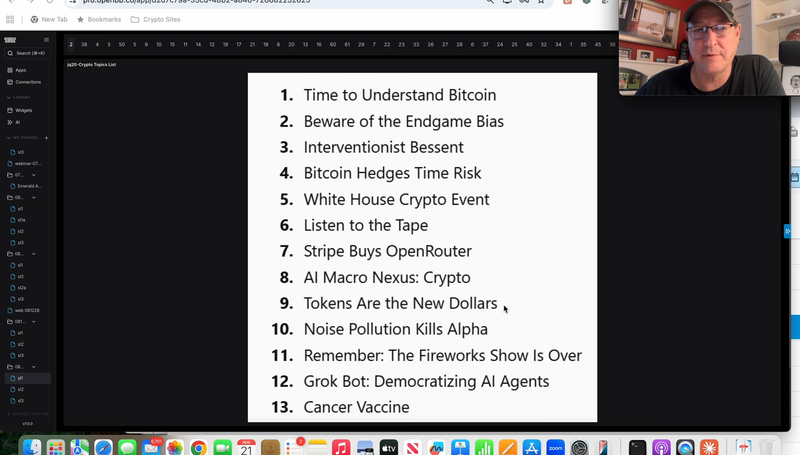
Explore how AI agents, Bitcoin, tokenized finance, and policy shifts could reshape market structure, monetary institutions, and investment.
Read the analysis
In the August 19, 2026, episode of the Century of Plenty Podcast, Sven Smit, Chris Bradley, Nick Leung, and Marc Canal argue that achieving an 8.5x global economy is constrained by cultural mindsets and regulatory friction rather than physical limits.
Read the analysis
In the August 18, 2026 episode of Moonshots with Peter Diamandis, guest Alvin Graylin argues that the US-China artificial intelligence race is fundamentally mischaracterized as a zero-sum competition.
Read the analysis
Explore how GPT-4 access improved consulting output quality and speed on some tasks while reducing correctness on others in a field experiment.
Read the analysis
On July 22, 2026, FoundMyFitness podcast guest Derya Unutmaz argued that AI could accelerate medicine enough to extend healthy life substantially.
Read the analysis
On August 11, 2026, the Dwarkesh Podcast featured Ryan Greenblatt's conditional case that human-level systems trained for verifiable AI R&D could initiate rapid recursive improvement.
Read the analysis