The BIP-110 Choice: A Map of the Communities Behind Bitcoin's Data War
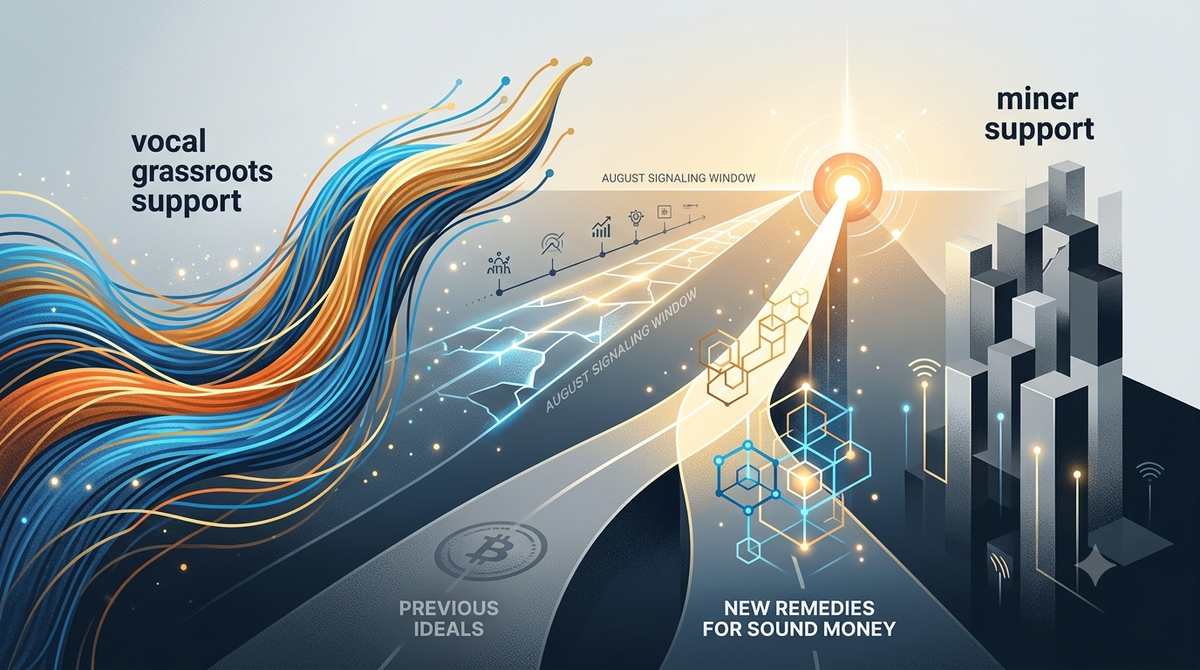
A proposal with vocal grassroots support is entering its August signaling window with minimal miner support. The reason is not that Bitcoiners have stopped caring about sound money. It is that sound money commitments now point toward different remedies.
Bitcoin's most contested governance proposal in years is approaching its decisive window, but still with almost no one mining for it. As of early July 2026, BIP-110 signaling remains below 1% of recent blocks, a rough proxy for supporting hashrate, and some signaling periods have been zero. No major pool has joined OCEAN, the pool founded by Luke Dashjr, in signaling support. The proposal has still consumed hundreds of hours of podcast and livestream discourse, hardened the community into openly hostile factions, and turned the phrase "Core versus Knots" into a shorthand for a dispute that is more complicated than that label implies.
As part of my Bitcoin horizon scanning research, I have spent 4 years building a structured record of long-form Bitcoin discourse from podcast and video interviews. Read based on stated positions in public interviews, the BIP-110 debate does not divide simply into two camps. Instead, it divides into six; that configuration helps explain the gap between the volume of the argument and the silence of the hashrate.
What is BIP-110 and how did the network arrive here?
BIP-110, the Reduced Data Temporary Soft Fork, is a one-year, self-expiring tightening of Bitcoin's consensus rules, authored by the pseudonymous Dathon Ohm in October 2025. It restricts the ways a transaction can carry non-monetary data, capping several data fields and, more to the point, curbing the Taproot witness techniques that ordinals inscriptions and the tokens built on them rely on; coins that already exist are exempt, so nothing on the chain today is frozen. Its trigger was Bitcoin Core's v30 release, which lifted a long-standing default limit on one such field (OP_RETURN) – defenders called that harm reduction, critics a green light for treating the base layer as a data store, and BIP-110 is the critics' countermeasure.
The dispute predates the proposal. It runs back through the 2023 wave of inscriptions and tokens to the 2017 block size war, and each round restates one epistemic question: is Bitcoin's base layer money or a settlement surface open to whatever pays the fee? [See my draft book chapter for an institutional economics take on the dispute and the role of epistemic values on lower-level implementation and operational rules.]
BIP-110 inherits the block size war's activation method, the user-activated soft fork (UASF), which lets node operators - not miners - ultimately force a rule change. Miners can lock it in early by signaling support in 55 percent of blocks across a two-week period; failing that, a mandatory window opening near block 961,632, in the first half of August 2026, has upgraded nodes reject any block that does not signal – the step designed to force the outcome without miner cooperation. What makes the moment consequential is less the proposal's text than that choice of mechanism, which places the decision with users and compels the community to show where it stands.
The six communities
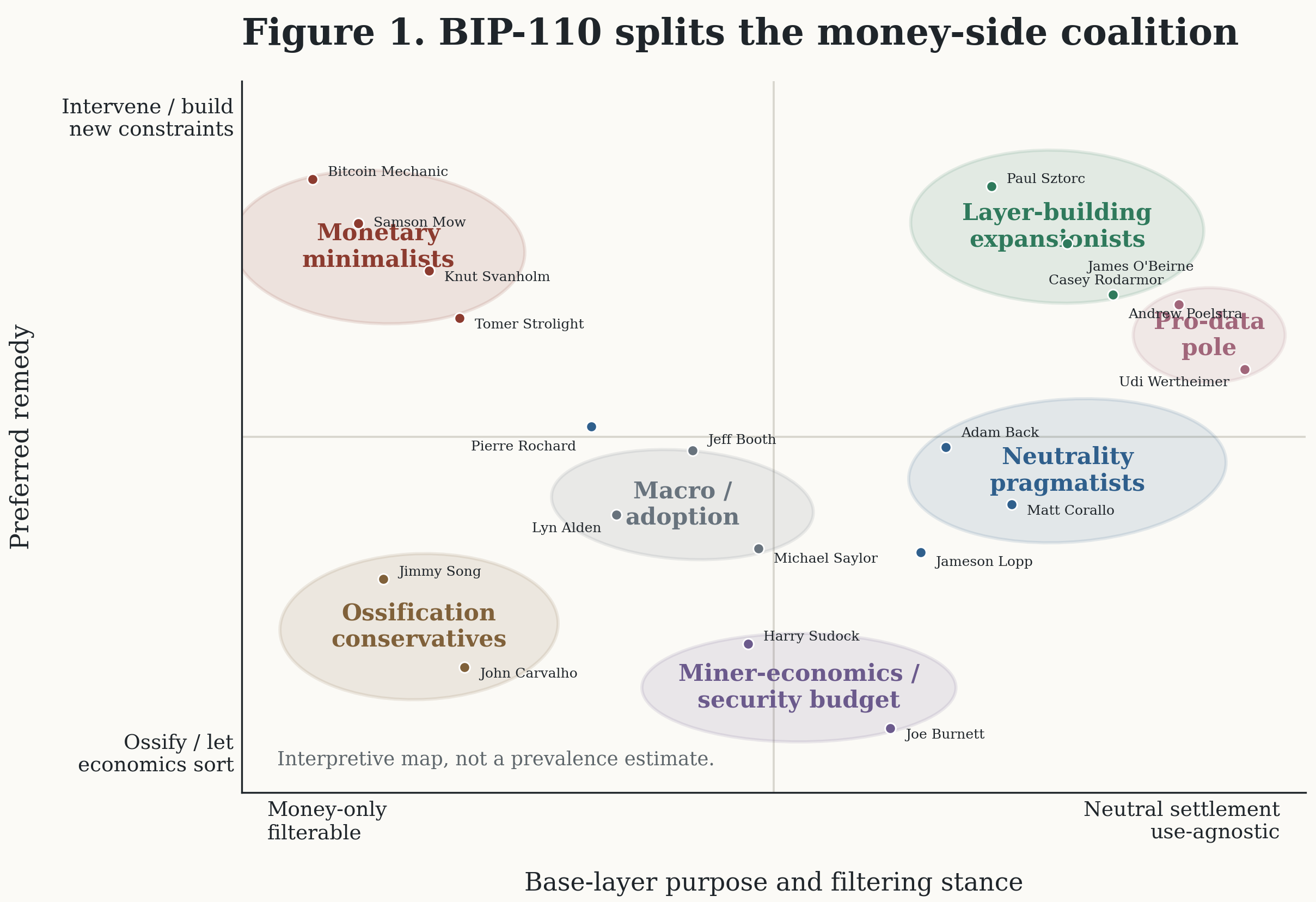
The six communities below are configurations of position, not factions with some kind of membership cards or secret handshake. They combine views about non-monetary data, base-layer purpose, filtering, consensus change, miner revenue, and the long-run security budget. They map the money-side discourse rather than the whole field; the under-sampled pro-data pole, a seventh community, appears later as a boundary condition.
01 - Monetary minimalists
Monetary minimalists view the base layer function of Bitcoin only as money and node operators may legitimately refuse to relay data that degrades it. Inscriptions and tokens are spam because they dilute fungibility, crowd out payments, and increase the cost of running a full node. This is the community that most closely tracks the Knots and Dashjr lineage, voiced in the interview record by figures such as Bitcoin Mechanic, Knut Svanholm, Tomer Strolight, and Samson Mow. Some want filtering at the level of relay policy and node defaults, while others are willing to pursue filtering at the level of consensus. BIP-110 belongs to the second position, not simply to the money-only impulse as such.
02 - Neutrality pragmatists
Content-based filtering is futile, dangerous, or both. Miners include whatever pays; direct-to-miner submission bypasses relay defaults; and when blocks fill, the fee market crowds out bulk data on its own. The deeper objection is precedent: a rule that discriminates on content creates a lever that can later reach financial transactions. Adam Back argues the precedent case most forcefully, Matt Corallo and others carry the scaling-and-fee-market version, and the Core v30 harm-reduction rationale belongs here. This is the case against BIP-110 on principle rather than on taste.
03 - Layer-building expansionists
Data pressure is a design problem, best handled by moving functionality upward rather than policing the base layer. This community favors covenants and Layer 2 systems: narrow primitives such as OP_CHECKTEMPLATEVERIFY (CTV) and vault constructions; merge-mined sidechains; and federated systems. Paul Sztorc's drivechain advocacy, James O'Beirne's covenants-first position, and Andrew Poelstra's verification-focused work anchor the position. Its instinct is to route the fight around the base layer by giving data and experimentation somewhere else to go.
04 - Ossification conservatives
This community shares the monetary values of the minimalists and draws the opposite operational conclusion. If Bitcoin is strongest when its rules change as rarely as possible, then an activist filtering soft fork is itself suspect. Jimmy Song's emphasis on ossification as a source of strength and John Carvalho's skepticism toward governance "fixes" that overpromise both sit here. The answer is to let economics and time resolve the data fight and to hold a high bar against any consensus change – including one advertised as a defense of monetary purpose.
05 - Miner-economics and security budget
For miners and security budget analysts, the dispute is about revenue as much as purpose. Data transactions are income, fee spikes are cyclical, and the protocol should not be re-architected around a temporary fee slump. This community is thin in the interview record because it acts more through blocks than through podcasts. Its revealed preference is currently deciding the outcome.
06 - Macro-monetary and adoption
For macro-monetary and adoption-oriented voices, the filter war is usually a cohesion risk rather than the central question. Lyn Alden, Michael Saylor, Preston Pysh, and similar figures engage Bitcoin as money at the macro-level and treat internal governance conflict as a threat to the monetary brand. Jeff Booth is the more interesting boundary case: he frames the contest as node sovereignty against concentrated financial weight, which leaves him agnostic on the filter while placing him firmly in vanguard of the sovereignty-first camp (see draft Chapter 08, Bitcoin Worlds, in my current book project).
Why "sound money" does not mean "filter support"
The sound-money impulse is not a bloc. It splits between interventionists who want filtering and ossifiers who want consensus touched as rarely as possible. Both hold that Bitcoin is money. They disagree on whether protocol intervention is a legitimate way to defend that claim.
That split reshapes the math of BIP-110. Opposition comes from at least three directions at once: the neutrality case that filtering is illegitimate; the ossification case that a rushed consensus change is the danger; and the futility case that filters cannot hold against miner incentives. Active support comes from only part of one community. A proposal facing three independent sources of opposition and a single divided source of support does not command consensus, however loud the sound-money sentiment behind it sounds. Near-zero signaling does not show that few people care about Bitcoin as money. It shows that the people who care are divided on the remedy.
The figures who break the tribal reading
The terrain is configurational rather than tribal and the most instructive figures are the ones who don't sit cleanly in one cell.
- Adam Back holds hard-money values by conviction yet opposes filtering outright and builds sidechain and bridge infrastructure. His placement among the neutrality pragmatists, not the minimalists, shows that Bitcoin-as-money does not imply protocol-level content rules.
- Pierre Rochard voices genuine "block-space zoning" sympathies while judging the filter futile and short of the consensus it would need to hold. He is a minimalist by value and a pragmatist by remedy.
- Jimmy Song refuses to endorse BIP-110 or to oppose it, grounding the refusal in a dynamic systems argument that the second- and third-order effects of any consensus change cannot be known in advance. His position is not indifference: he treats Bitcoin as money precisely because it should change rarely, while also accepting that decentralized rule choice is how such disputes are ultimately tested. That leaves him aligned with the ossification conservatives by remedy, even as BIP-110 supporters read his refusal as fence-sitting.
- Jameson Lopp warns that a low-threshold UASF raises the risk of a chain split in which two chains contend to be the real Bitcoin. His concern is procedural rather than doctrinal, and it cuts against activation even among those sympathetic to the minimalist cause.
Song and Lopp expose a second axis: a stance on the desired outcome is distinct from a stance on who may legitimately force the question. Both decline to endorse BIP-110. Song treats user rule choice as part of Bitcoin's decentralized process; Lopp emphasizes the procedural danger of a low-threshold activation attempt. They converge on non-endorsement and diverge on governance legitimacy.
However one might refine the actual divisions and who belongs in what community, the two-camp story certainly collapses. The dispute is a space of positions and people can move through it.
Discourse volume versus activation power
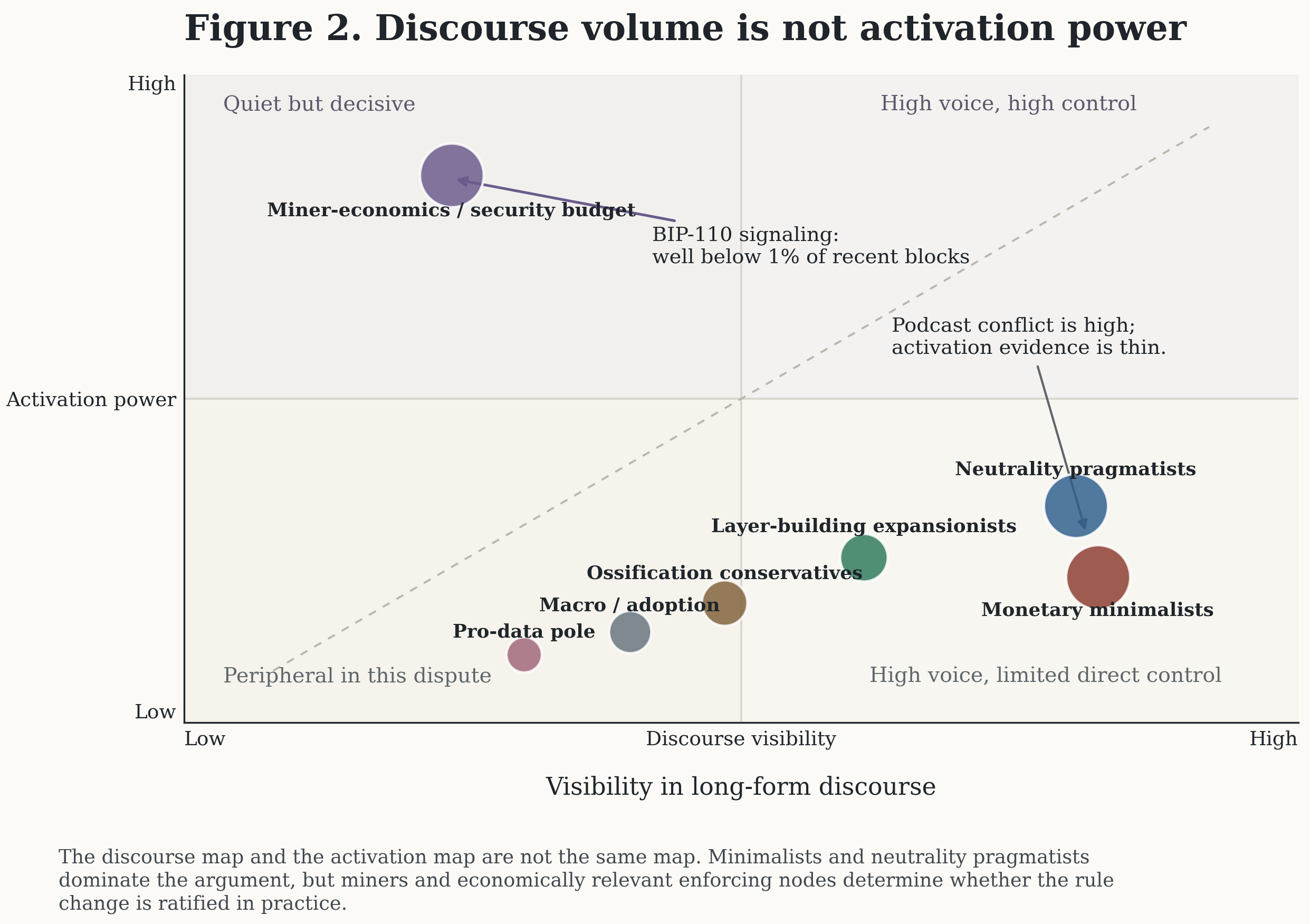
The communities loudest in the discourse – the minimalists and the pragmatists – are not the ones that decide activation. Miners are least present in the interview record and most consequential in the activation record (Figure 2). Their instrument is not the podcast but the block. Signaling well below one percent of recent blocks, with no major pool joining OCEAN, is not indecision. It is a decision expressed in the medium that binds.
BIP-110 is not on the verge of network-wide activation; it is approaching a decision window in which its supporters choose whether to force the question, and two paths remain. In the first, the miner threshold goes unmet, few economically relevant nodes enforce the mandatory signaling rule, and the proposal fails socially even though its state machine has no ordinary timeout. In the second, a minority of nodes running the reference implementation begin rejecting non-signaling blocks during the mandatory window regardless of miners. That is the UASF mechanism working as designed.
The 2017 precedent shows that a UASF can succeed when overwhelming economic weight stands behind it. Current evidence of BIP-110 enforcement appears thin. A UASF without economic weight is how chain splits happen. The August choice is less whether BIP-110 activates than whether its supporters press an enforcement action the network is not positioned to ratify.
That is the institutional point I develop more fully in my draft Chapter 3, When exit is the only voice. Bitcoin can enforce operational rules with extraordinary precision but it has no comparable mechanism for binding disputes about what the protocol is for. Above the operational layer, disagreement is settled through client choice, miner behavior, market coordination, or chain split risk. BIP-110 is therefore not just a fight over data: it is a case of governance form mismatch, a dispute that requires collective judgment but offers exit as the only binding instrument for Bitcoiners' to represent their conflicting views on what Bitcoin is best used for.
An Opus 4.8 forecast: how the August choice likely resolves
I asked Claude Opus 4.8 to project the outcome from the community structure above and the signaling data as of early-July 2026. Its analysis follows, with its own reasoning and call:
"The base case is that BIP-110 does not activate on Bitcoin's economically dominant chain. The miner-driven path is effectively closed: signaling has held near half a percent of hashrate since May, nearly all of it traceable to Ocean, with no major pool following since March. Reaching the 55 percent early lock-in from there within weeks would require a coordinated reversal for which no evidence exists.
The mandatory signaling window carries the residual uncertainty, and it resolves into two outcomes rather than one. When enforcing nodes begin rejecting non-signaling blocks in August, that enforcement binds only the nodes actually running the new rules, a share estimated in the low single digits. With negligible hashrate and no major exchange or pool committed, the flag day yields either a quiet lapse, as the enforcing minority declines to sustain a chain no one else follows, or a brief minority split that resolves against the proposal because the fork carries almost no economic weight. The first is the more probable; a persistent split threatening the main chain is the least probable of the three.
This is what the community map implies. Support draws from only the interventionist wing of one community, opposition arrives from three directions at once, and the deciding actors – the miners – hold a revealed economic preference against the change. One event would move the forecast: a large pool such as Foundry USA or Antpool beginning to signal would convert daily counts from noise into a plausible path within days. Absent that, the numbers describe a loud campaign with little binding power.
Two caveats hold. The projection rests on a discourse-derived structure and current signaling, not a model of miner behavior, so a coordinated shift the corpus cannot reveal would break it. And because demonstrations already show that data survives the restrictions, even activation would not settle the underlying question, which returns at the next data cycle regardless of the August result."
What is actually at stake beyond August
BIP-110 is temporary by construction but three durable issues remain after the signaling window closes. The first is precedent. Many participants treat content-based consensus rules as an uncrossable line. The debate has forced that line into the open regardless of how signaling resolves. Even critics who dislike the current data uses worry about the tool. A rule that discriminates by content is a capability, and capabilities outlast their first use.
The second is the activation mechanism. BIP-110 is a live test of whether a motivated minority can drive a consensus change through a low-threshold UASF without maintainer or miner support. Bitcoin's lack of formal high-level governance means precedents are set by episodes rather than statutes. The answer the network gives in August will shape how the next contested proposal is attempted and by whom.
The third is the security budget. As the block subsidy continues to halve, network security will rest increasingly on transaction fees, and data transactions are a real, if volatile, source of those fees. The miner-economics community is thin in the podcast discourse today but its concern recurs every cycle and grows with each halving. If fee revenue from non-monetary data comes to be seen as load-bearing for security, the pragmatist and miner positions converge into the dominant coalition. The minimalist filter case then gets harder to make, not easier. So, the data question does not end in August: it returns, perhaps framed in new vocabulary, at every subsidy reduction.
A note on method and its limits
The maps in this analysis were built from a 3+ year corpus of long-form Bitcoin interviews, read interpretively for the positions speakers take rather than sorted by affiliation. It is a typology – a structured account of the fault lines and who voices them – not a measurement of prevalence. I make no claim about what share of the community holds each position, only about the shape of the positions and how they relate.
The dataset contains 6,231 podcast transcriptions dating from 01 January 2023 to 12 March 2026 (my current cutoff for horizon scanning research). The caveat there is that some community members may have shifted their support regarding BIP-110 since then. For some, I drew on additional information recently available to see if that moved which community they were grouped into (e.g., Jimmy Song's recent long twitter post on his position, which did not shift his community membership).
I used Claude Opus 4.8 for the community clustering. In the past when doing this kind of discourse analysis, I would have first used a traditional text mining software, created a dictionary of terminology that differentiated positions, and then run a latent class cluster analysis on the dictionary entries themselves, tying them back to particular podcasts and interviewees. For the informal analysis in this blog post, I did not formally test Opus results relative to latent class clustering, something I would have done if the results were bound for a peer-reviewed journal. To me, the Opus output makes sense but there is a caveat here to be aware of.
Two representation biases matter. The operator base of the minimalist community, the people running filtering nodes, is underrepresented among interview subjects relative to its weight at the node level, so this community's footprint in the discourse may understate its presence in the network. The corpus also skews toward sound money, so the broader legitimate-use pole – figures such as Casey Rodarmor and Udi Wertheimer, who treat non-monetary data as valid use rather than abuse – is under-sampled and intentionally unhoused by the six-community map (see Figure 1). Read the clusters as a guide to the terrain, not a census of it.
For the institutional economics version of the argument, see the chapter 3 draft in my upcoming book When Policy Falls Behind: Bitcoin, AI, and the Governance of Fast Systems, where I treat the Core v30/Knots dispute as a governance form mismatch.

Comments ()