Chapter 07. Bitcoin’s role as temporal infrastructure

This is the July 2026 draft of chapter 07 in my new book, When Policy Falls Behind: Bitcoin, AI, and the Governance of Fast Systems. Copyright © 2026 by Murray A Rudd. A pdf version of this chapter is available at: https://dx.doi.org/10.2139/ssrn.6630139
Introduction
Accelerating technologies can generate operational facts, market signals, and strategic options faster than individuals and organizations can interpret them and form the long-horizon judgments that a binding investment or policy response requires. In Part 1 of this book, important Bitcoin governance challenges all carry this signature. Relay disputes, energy governance legitimacy conflicts, custody financialization, and quantum migration all turn on a mismatch of speeds, located in the gap that fast systems create between algorithmic velocity and institutional latency. That gap has a consequence beyond delayed response: sustained exposure to accelerating algorithmic velocity and informational turnover changes the conditions under which actors remember the past, attend to the present, and deliberate about the future.
Algorithmic trading compresses the interval between information and market price; recommender systems shape which information becomes salient before deliberation begins; and AI systems generate policy analyses and options faster than the governing bodies meant to evaluate them can respond (Jumper et al., 2021; Noy and Zhang, 2023; Jadhav and Mirza, 2025; Liang and Zhang, 2025; Dell’Acqua et al., 2026; GESDA, 2026). The constraint across these settings is the pace of informational turnover rather than just the volume of information. When the authoritative background against which actors deliberate is continually revised or displaced, the effort required to hold a stable long-horizon view rises even as the information available for decision-making grows.
Informational turnover of this kind bears on temporal judgment asymmetrically. Compressive dynamics shorten the effective horizon by degrading the memory, attention, and reference points on which long-horizon deliberation depends – a pattern that Heymann and Leijonhufvud (1995) observed in high-inflation economies and called “the telescoping of time.” Expansive dynamics move in the other direction, preserving durable temporal structure through commitment devices that survive informational churn. The governance form in play shapes whether long-horizon judgment can be sustained when the informational background will not hold still.
Economics treats time preference as a psychological parameter, documenting its heterogeneity and behavioral consequences, usually without any consideration of the institutional conditions under which a given time preference is revealed (Frederick et al., 2002; Cohen et al., 2020). As they accelerate, contemporary technologies have thus put pressure on temporal infrastructure, weakening governance forms whose value lies in holding reference points fixed even when ordinary deliberation cannot. Bitcoin may seem an unlikely candidate as an institutional commitment mechanism with a distinctive temporal structure because it is usually analyzed as money or as an investment asset rather than as an institution.
Long-horizon judgment under acceleration can be viewed as one determinant of adaptive capacity, not a fixed trait of individuals, and it is gained or lost through ossification and changes in governance form. Three compressive mechanisms – memory decay, attention compression, and optionality expansion – account for how it erodes; institutional commitment is the countervailing form that preserves it. Bitcoin supplies a contemporary instance of institutional commitment because its fixed issuance, resistance to discretionary revision, and halving rhythm holding some baselines explicit enough to anchor long-horizon expectations.
Time preference is the concrete channel through which these effects register. Whether holding Bitcoin under self-custody lowers the time preference its holders reveal, or whether actors who already weight the future more highly are more likely to adopt Bitcoin, is an empirical issue. Lower time preference should help loosen society’s focus on short-term decision-making regarding consumption and investment, as well as engage in forward-thinking volitional choice, the aspirations about what type of future world they want (Rudd, 2000). Bitcoin’s temporal architecture, I argue, may hold potential to increase adaptive capacity as technological progress accelerates.
Theoretical framework
Economics has typically treated time preference as a psychological parameter. Behavioral research documents wide heterogeneity across individuals and populations (Laibson, 1998; Frederick et al., 2002; Cohen et al., 2020) and maps it onto outcomes such as saving and health behavior (Meier and Sprenger, 2010; Bradford et al., 2017), with cross-cultural variation that individual psychology alone does not explain (Rieger et al., 2021). This treatment under-emphasizes the institutional condition under which a particular time preference is revealed.
Taking a pragmatist and institutional perspective (Bromley, 2006; Rudd, 2023), I view preferences as emerging inside rule structures rather than prior to them. The means that governance form shapes what actors can see, weight, and act on. If the informational substrate of deliberation and intelligent inquiry changes, the time preferences revealed within it can change as well, leaving discount rates being treated as structural constants resting on ground already in motion. Psychological determinants – perceived mortality risk, impatience, uncertainty, and inflation – still operate but alongside an institutional channel concerning the informational environment within which judgments about temporal distance and stability are formed.
That institutional channel places time preference on the volitional side of the distinction Chapter 2 draws between computational knowledge and volitional choice. Computation optimizes against given objectives; volitional choice concerns which objectives there is reason to adopt. Temporal horizons are volitional in exactly this sense, since they express judgments about which future states count, whose future claims bind, and how far present responsibility extends.
Whether decade-scale outcomes register, whether intergenerational obligations hold, and whether the long-run consequences of technological choices fall within present decision-making are settled at the epistemic level, where a society’s slowest-moving commitments sit (Ostrom, 1997). Institutional latency is most consequential there because epistemic commitments are difficult to observe and erode less through explicit repeal than through inattention. When the informational environment offers fewer occasions to exercise long-horizon judgment (Godin, 2010; Marchant et al., 2011), the background commitments that sustain it weaken, and algorithmic velocity deepens that latency rather than creating it.
Informational turnover reaches temporal judgment through four pathways, each a specific form of the displacement Chapter 2 identified in evidence, attention, memory, and reference points. Memory decay shortens the usable past; attention compression reduces sustained engagement with the present; optionality expansion multiplies future states faster than judgment can settle them; and reference degradation erodes the fixed points against which any of these can be assessed. The three compressive mechanisms commonly operate through financial markets, algorithmic content environments, and AI-generated option sets, each an example of one pathway. Reference degradation is addressed by an institutional commitment device, which supplies the durable reference point the other three erode.
Informational turnover differs from adjacent concepts: a setting can be uncertain, complex, or information-rich without the substrate of deliberation turning over quickly, pointing to the need for bolstering both near-term recognition capacity to keep pace and long-term deliberative capacity to come to binding decisions about what it is best to want.
Compressive case 1: financial markets and memory decay
The shortening of market memory
Market memory – the duration over which historical events retain influence on current deliberation, beyond the availability of information about them – can be observed through the shortening in the duration of bear market across successive cycles. The February 2020 pandemic drawdown, the April 2025 tariff-driven volatility, and the rapid 2026 recovery to record market highs during the Iran conflict[1] all point toward a contraction in that memory (Dąbrowski, 2022; Rao et al., 2025). Standard explanations emphasize faster central bank intervention, algorithmic trading, and reduced lag between information and price (Hendershott et al., 2011; Chaboud et al., 2014; Weller, 2018; Bernanke, 2023). Those factors explain the speed of recovery and the potential for algorithmic reflexivity but they do not necessarily explain why investors give historical experience less weight in current deliberation, a question of memory rather than of price discovery.
How memory decays
Memory decay turns on how far back the informational substrate of current deliberation extends. An investor in 1990 could still draw on a professional tradition that kept the 1929 crash, the 1937 reversal, the 1973–74 oil crisis, and the 1987 crash active through textbooks, training, and practitioners’ direct recollection (Tversky and Kahneman, 1973; Kindleberger and Aliber, 2005; Malmendier and Nagel, 2011). An investor in 2026 operates in a high-velocity informational environment where the constraint is no longer access to historical information but whether that information remains institutionally relevant and present for current deliberation.
The institutional economics take is that decay is produced by the interaction between informational turnover and the cost of maintaining historical salience (Simon, 1971). Disclosure cycles, regulatory requirements, research practice, and training determine which historical information stays authoritative. When information generation accelerates, the apparatus that maintains historical salience faces rising costs relative to perceived benefit (Walsh and Ungson, 1991; Veldkamp, 2011). Research shifts toward shorter-horizon commentary, risk management relies on shorter data series, and education devotes less attention to reference events practitioners no longer cite.
Bitcoin financialization and time preference
Bitcoin financialization (Chapter 5) exhibits the same mechanism. Bitcoin’s institutional meaning is built partly from long memories of monetary instability, payment censorship, custody failure, protocol conflict, and the repeated failure of centralized intermediaries to preserve the properties they claimed to represent. Those memories do not remain active automatically once Bitcoin is held through exchange accounts, funds, or professional allocations. As Bitcoin becomes legible through traditional financial categories, the reference events that once organized judgment about self-custody, verification, issuance credibility, and exit become more like background lore rather than operative evidence.
The shift requires no misrepresentation. A portfolio committee evaluating Bitcoin as a risk asset, an exchange designing a yield product, and a wealth manager explaining allocation size may each act competently within their governance form. The compression occurs when a system designed around a multi-decade monetary commitment is interpreted through quarterly performance windows, constant benchmark comparisons, and volatile global liquidity conditions that operate on much shorter cycles.
Governance form selection responds to transactional attributes (Williamson, 1985, 1999). Deliberation faces transaction costs in sustaining historical context and when the cost of maintaining long-horizon memory rises relative to operating on shorter horizons, the governance forms that emerge are calibrated to shorter horizons. Memory decay then raises effective time preference through two compounding channels: the indirect channel runs through uncertainty, as a compressed evidence base raises effective uncertainty and discount rates; and a direct channel operates when the deliberative infrastructure supporting long-horizon judgment atrophies regardless of formal uncertainty. The two compound because reduced historical relevance raises measured uncertainty while degraded deliberative capacity reduces the ability to work with whatever long-horizon information remains.
Compressive case 2: algorithmic content and the compression of attention
Recommender systems as institutions
Recommender systems mediate a large share of the informational inputs through which deliberation now occurs (Ricci et al., 2022; Liang and Zhang, 2025). They are institutional rather than merely technical: they shape participation, position, payoff, and information rules (see Chapter 2) before information users even encounter choice opportunities, allocating visibility and rewarding some forms of participation over others to produce collective outcomes no individual selects (Gillespie, 2014; Pasquale, 2015; Just and Latzer, 2017).
The filter bubble, surveillance capitalism, and amplification literatures document the harms of digital curation (Pariser, 2011; Bakshy et al., 2015; Vosoughi et al., 2018; Zuboff, 2019). Prior to those harms, these systems make operational level decisions about content exposure within established rules and norms, sanctioning non-compliant dissemination (Roberts, 2019). Implementation level governance remains internal to the firms that set optimization targets; political level governance remains too weak to define the purposes those systems should serve; and epistemic level commitments about what informational environments are for remain largely absent. That thin architecture gives recommender systems wide discretion without requiring their deliberate manipulation: engagement correlates with revenue; revenue sustains the system; and the system is optimized accordingly (Pasquale, 2015; Zuboff, 2019). The informational environment is left unprotected while engagement maximization erodes temporal architecture and the depth of the inputs that deliberators receive.
The compression mechanism
Attention compression follows from the interaction of novelty bias, fragmentation, and feedback. Novelty bias tilts inputs toward the present (Wu and Huberman, 2007; Ciampaglia et al., 2015); fragmentation shortens the unit of engagement (Lorenz-Spreen et al., 2019; Carr, 2020); and feedback closes the loop as users adapt to rapid cycles and their reduced tolerance for slower material reinforces the bias toward shorter inputs. The result functions as a tragedy of the commons for attention, in which the deliberative capacity that supports enduring judgment is depleted by the rules-of-the-game within the system. Individual users may adopt strategies of resistance or digital discipline but the payoff and information rules of the action situation remain biased toward immediacy, and the aggregate outcome is decay of the infrastructure required for sustained deliberation (Simon, 1971).
Compressed professional and Bitcoin discourse
The pressure extends beyond consumer settings. Professional knowledge systems increasingly face demands for faster turnaround and shorter formats (Millo and MacKenzie, 2008; Marchant et al., 2011; Usher, 2014; Höchtl et al., 2016; Johann et al., 2024), and Bitcoin discourse passes through the same compressed environments. Bitcoin’s public meaning depends on distinctions that may be slow to acquire and easy to collapse: protocol validity is not institutional legitimacy; intermediated exposure is not self-custody; PoW is both a security mechanism and an energy governance claim; and fixed issuance is both a rule and a credibility commitment. Compressed discourse can convert these kinds of distinctions into dogmatic positions or memes. The same disagreement acquires different institutional meanings as fragments move through different information systems, so access to source documents does not by itself preserve the distinctions judgment requires.
Compressive case 3: AI optionality and the overloading of volitional choice
Optionality expansion
AI systems generate candidate options of what there is to want faster than deliberation can evaluate them. The expansion of what actors might want is not new – institutional, technological, and cultural change have always enlarged the menu of possible purposes (Romer, 1990; Veblen, 1992 [1899]; Sen, 1999; Scheibehenne et al., 2010) – but generative systems change the speed and surface plausibility of option production, so that reviewing the option set becomes part of deliberation rather than a preliminary sort. The same pressure arrives through search rankings, software recommendations, and AI-augmented defaults even when the deliberator does not see how the set has been shaped. It appears wherever generated alternatives outrun the institutions meant to evaluate them (Zenil et al., 2026): policy analysts receive draft variations faster than legislative purpose can be clarified; investment committees face strategy sets larger than their meetings can handle; and Bitcoin-facing institutions confront custody designs, compliance pathways, and portfolio strategies multiplying faster than participants can deliberate over the purposes those options should serve.
The volitional trilemma
The overload follows from the asymmetry between computational knowledge and volitional choice. AI generates options, models consequences, and optimizes against specifiable criteria at advancing speed, while volitional choice remains slower because it concerns which objectives are worth adopting, how conflicting purposes should be weighed, and who accepts responsibility for consequences (Bromley, 2006).
The deliberator then faces a trilemma in which each response weakens the volitional function: delegation lets the AI’s ranking become the operative answer; truncation limits consideration to a subset of options whose selection bias cannot be assessed; and extension preserves deliberation in principle but surrenders it in practice when the decision arrives after the operational window has closed. The trilemma is a manifestation of institutional latency at the scale of individual and organizational deliberation, and it does not dissolve with additional effort because the asymmetry is structural. What may begin as computational support for volitional choice drifts toward computational substitution for it, as the work of framing, selecting, and weighing options migrates into the systems that generate them, each step preserving the surface structure of intelligent inquiry while hollowing its content.
Economizing under overload
Optionality expansion raises effective time preference through the future-facing side of deliberation, distinct from the past that memory decay shortens and the present that attention compression fragments. When possible futures expand faster than judgment can settle them, actors economize in ways that raise discount rates: horizon-shortening restricts attention to candidates operating on shorter horizons; default acceptance treats the highest-ranked option as the path of least resistance; and volitional deferral postpones commitment and lets the status quo trajectory continue under conditions unlikely to improve.
Deferral is most consequential where the decision space contains irreversible thresholds, since expected-value reasoning can rationalize waiting under uncertainty yet fail catastrophically when a threshold is breached before deliberation concludes (Sunstein, 2005; Weitzman, 2009). The three economizations reinforce one another and the problem is acute for decisions that require sustained commitment across long horizons – custody design, protocol migration, monetary credibility, public policy – because they cannot be decomposed into short sub-decisions without losing their character as commitments.
Computational knowledge and volitional choice under acceleration
Across the three cases, algorithmic velocity and informational turnover rise faster than the institutional capacity to maintain historical depth, sustained attention, and future-informed volitional choice. Institutional latency appears not only as delayed public response but as a weakened capacity to sustain long-horizon judgment inside markets, media systems, professional routines, and Bitcoin-facing institutions (Table 7.1). The countervailing form is institutional commitment. Commitment devices preserve reference points that stay available when the informational background turns over quickly, giving deliberators something stable against which to assess change, distinguish durable commitments from current noise, and decide whether a proposed adjustment is adaptation or drift.
| Mechanism | Temporal object | Institutional site | Channel to time preference |
|---|---|---|---|
| Memory decay | The usable past | Professional memory, disclosure, training | Compressed evidence base raises uncertainty and atrophies long-horizon deliberation |
| Attention compression | Engagement with the present | Recommender systems as action situations | Fragmented inputs raise the transaction cost of sustained deliberation |
| Optionality expansion | The set of possible futures | AI generation, ranking, and defaults | Horizon-shortening, default acceptance, and deferral raise discount rates |
Table 7.1. The three compressive mechanisms
Rigidity, however, can either supply temporal scaffolding or protect an arrangement whose justification has expired. A rule sustains long-horizon judgment when it remains connected to the problem it was designed to govern and becomes maladaptive when it blocks response after conditions have changed. Energy governance (Chapter 4) shows a fast operational system reaching political and epistemic institutions that lack a settled values filter; custody (Chapter 5) shows transaction cost economizing moving users toward intermediated governance forms while weakening the temporal discipline needed for self-custody; and quantum migration (Chapter 6) shows the reverse, a future threat requiring coordinated change against a protocol whose identity rests on resistance to discretionary revision (i.e., urgency alone cannot count as sufficient reason). Time preference is one channel through which governance form mismatch becomes consequential: when the available form shortens memory, fragments attention, or shifts decision work into defaults, actors can appear to prefer the present even though the institutional environment has shifted the discount rate and changed what the future costs and benefits look like from their position.
Bitcoin as an institutional commitment device
Long time horizons as an institutional resource
Long-horizon deliberation requires stable reference points against which change can be assessed (Tversky and Kahneman, 1973; North, 1990). When acceleration destabilizes those points, the sufficient reason required for long-horizon choice begins to dissolve (Bromley, 2006) because a deliberator whose every reference is itself under short-horizon revision has no fixed ground against which to evaluate drift. Pauly’s (1995) “shifting baseline syndrome” identified this loss in fisheries, where each generation treats inherited degradation as ordinary background, but the institutional logic is general. Durable reference points have three sources, each with its own dynamics: biophysical reference systems; institutional commitment devices; and historical reference infrastructure (Rudd, 2026).
Bitcoin is a candidate in the second category. Its parameters are explicit enough to make drift visible. A participant can observe whether issuance, validation, custody, or settlement discretion has changed, and in a high-turnover environment that visibility is itself an institutional resource.
Commitment devices have historically supplied this function by making revision costly, creating credible commitments (Williamson, 1985). The gold standard provided a long-horizon monetary reference by constraining adjustment across political cycles, though the same rigidity also created a pacing problem when the reference prevented adaptation to exogenous shocks (Eichengreen, 1992, 2019). Constitutional structures work through a similar logic, insulating deliberation from short-term pressure while accelerated political menus weaken the practical force of the mast to which a polity has tied itself (Elster, 2000). Persistence can be achieved through path dependence and transaction costs (North, 1990; Greif, 2006) but the temporal function of commitment devices is less developed. Where informational turnover is low, reference points often remain stable through inertia; where it is high, commitment devices become more valuable because they preserve fixed points tht ordinary policy debate may no longer supply.
Bitcoin’s temporal properties
Bitcoin exemplifies institutional commitment in a contemporary, algorithmic form (Nakamoto, 2008), functioning as an institutional object rather than only a monetary phenomenon or investment asset (Searle, 2005). Its temporal properties arise from the interaction of a fixed long-run issuance schedule, protocol-level resistance to revision, and the four-year halving rhythm. The issuance schedule is written into code but its force depends on validation discipline, implementation continuity, and users’ willingness to reject incompatible histories. Bitcoin functions as a commitment device because a distributed institutional arrangement makes discretionary revision costly, visible, and contestable, not because code mechanically binds the future. The supply schedule is a long-term reference point whose value in 2140 is specified by protocol rules with a precision unavailable in comparable institutional contexts (Catalini and Gans, 2020; De Filippi et al., 2020), supplying a synthetic commodity fixed where the stability of reference points has otherwise become scarce (Selgin, 2015; Allen et al., 2020).
Resistance to revision is Bitcoin’s more distinctive property: unlike monetary arrangements whose rigidity depends on commitments revisable by finance and governance actors, Bitcoin’s core parameters are protected by the high coordination costs any revising coalition would face (Bier, 2021; Gans and Halaburda, 2023). The schedule acquires significance from that resistance and the resistance acquires meaning from the parameters it protects. The halving cycle imposes a periodicity longer than most contemporary institutional rhythms – quarterly earnings, annual budgets, electoral terms – and calibrated to a horizon human deliberation can engage in extended form. The approach of each halving directs attention toward the protocol’s long-term structure, producing institutional occasions for deliberation that compressive mechanisms have made scarce elsewhere.
Custody, salience, and the two channels
Node validation and self-custody connect the long-run commitment to repeated routines of verification, storage, and exit readiness at the operational level, a defining characteristic of the habits emphasized within the Old Institutional Economics (Hodgson, 1998, 2004). These practices keep the boundary between direct protocol participation and intermediated exposure visible, and when users stop exercising them, their salience declines in the social world where Bitcoin is held, priced, narrated, and governed. Custody (Chapter 5) economizes on transaction costs by moving users into governance forms that offer convenience, recourse, and administration, and those benefits are real; a holder of an exchange balance or fund share, however, remains exposed to Bitcoin’s price and issuance narrative while the practices that make the protocol’s commitment personally salient weaken.
Effective time preference can therefore shift at the institutional interface even when protocol rules are unchanged, the reference-degradation pathway operating on a reference point that is otherwise intact. Bitcoin’s contribution to long-horizon deliberation runs through two channels – the existence of the anchor and its salience in practice – and financialization can leave the first in place while eroding the second. The two channels combine multiplicatively (Appendix A). Mathematically, an anchor investment lowers effective time preference and pushes institutional turnover level outwards (Figure 7.1). Higher anchor investment sustains a larger anchor stock at every level of turnover, which lowers effective time preference and shifts rightward the turnover at which the horizon begins to compress.
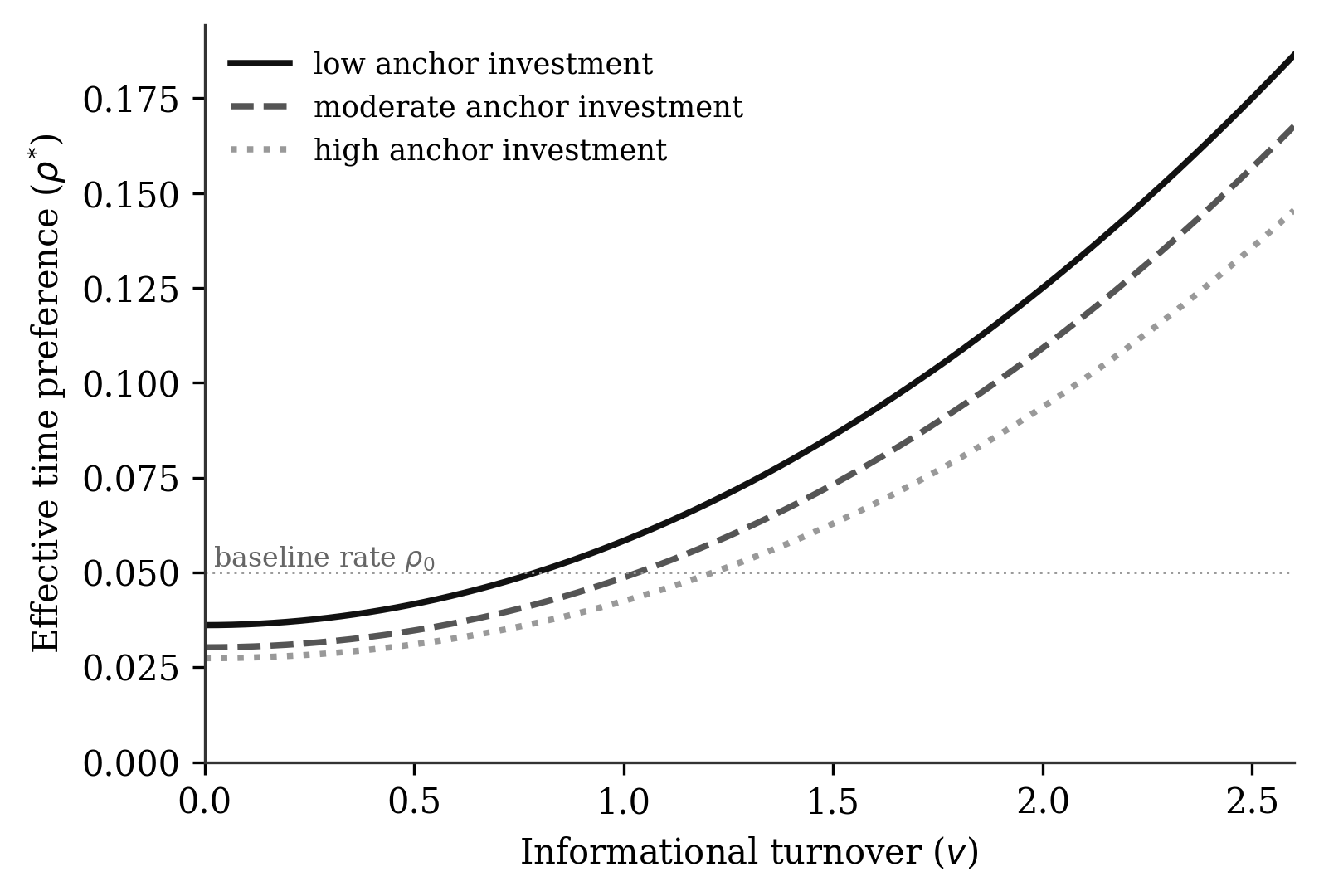
Figure 7.1. Effective time preference as a function of informational turnover, at three levels of anchor investment. Effective time preference (ρ*) is the baseline psychological rate scaled by an existence channel that falls as the anchor stock grows and a salience channel that rises convexly as turnover outpaces the capacity to keep the anchor salient. The parameter values are chosen to display the qualitative structure of the model, not empirical estimates.
Maintaining salience against rising turnover meets a limit: the effort required to hold effective time preference at its baseline rises convexly and eventually exceeds any attainable level (Figure 7.2).
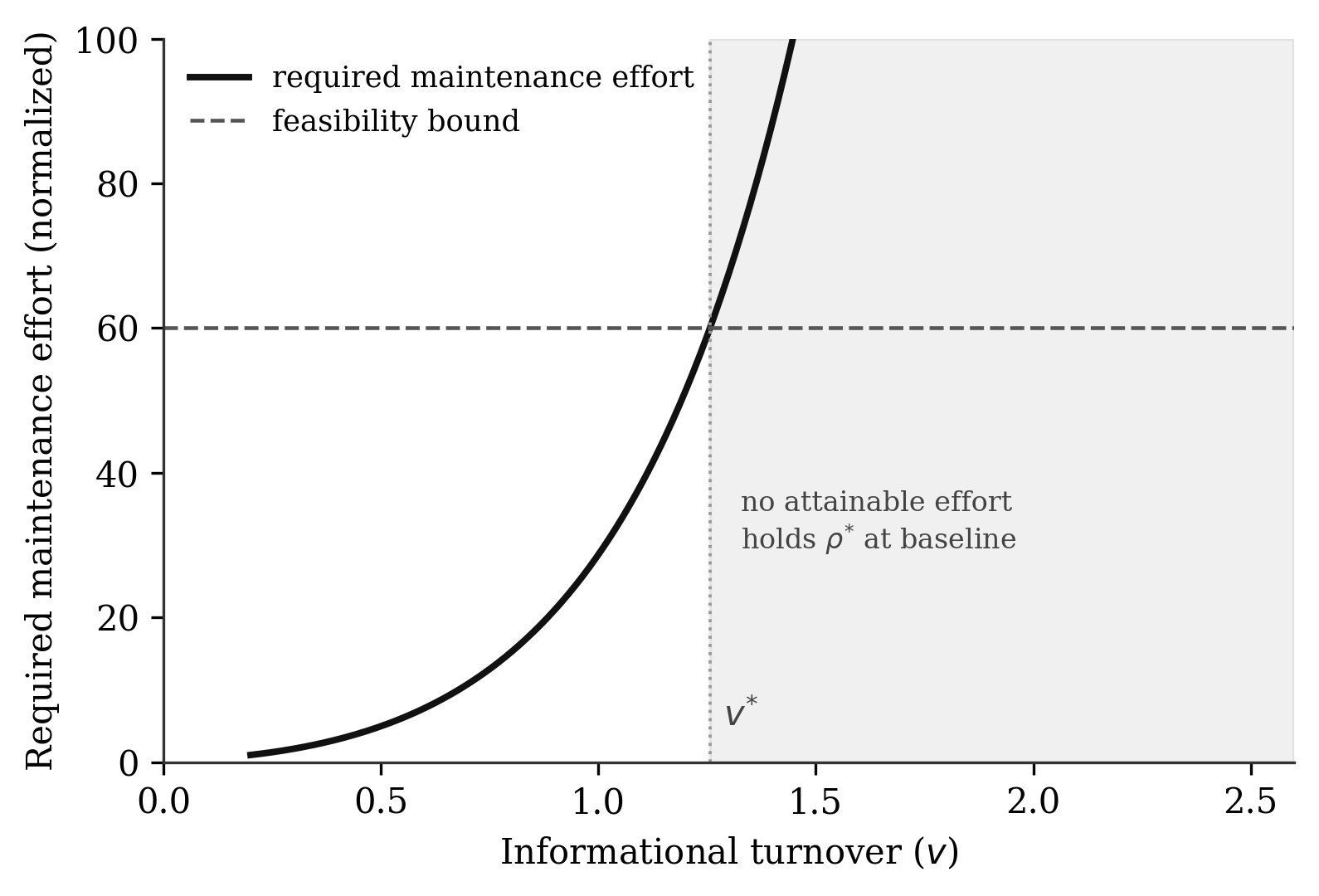
Figure 7.2. The offset condition. Holding effective time preference at its low-turnover baseline as informational turnover rises requires offsetting maintenance effort – validation practice, self-custody discipline, and institutional memory – that sustains the anchor and keeps it salient. Because capacity is supplied with diminishing returns while turnover erodes both channels, the required effort rises convexly and meets a feasibility bound at the critical level v*, beyond which no attainable effort holds the baseline (shaded region). The curve is schematic: parameter values are chosen to display the qualitative structure of the model, not to estimate magnitudes.
The same dynamics make erosion costly to reverse. The anchor stock depreciates quickly when turnover is high but rebuilds only slowly once turnover subsides, so a period of financialized intermediation that lets self-custody and validation practice lapse leaves effective time preference elevated well after the conditions that raised it have passed (Figure 7.3). Recovery is not the mirror image of decline, a directional asymmetry that connects the temporal argument here to directional institutional latency (Chapter 6).
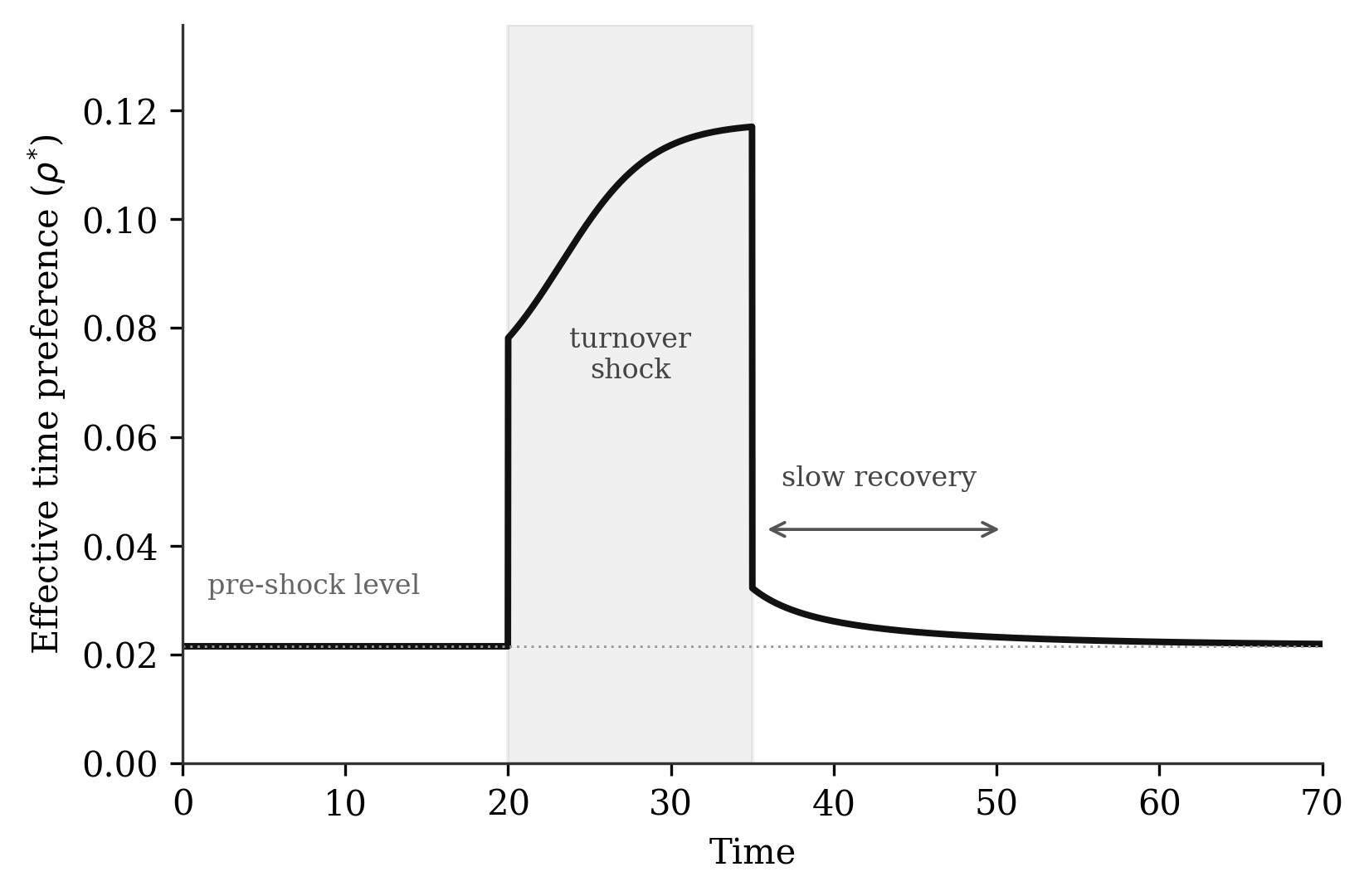
Figure 7.3. Asymmetric recovery after a turnover shock. A temporary rise in informational turnover (shaded) raises effective time preference (ρ*) almost immediately, as the salience channel inflates and the anchor stock begins to erode. When turnover subsides, effective time preference returns to its pre-shock level more slowly. The anchor depreciates quickly under high turnover but rebuilds gradually, so the horizon stays compressed well after the shock has passed. The lag is a form of directional institutional latency (Chapter 6). The path is schematic: parameter values are chosen to display the qualitative structure of the model, not to estimate magnitudes.
Time preferences and Bitcoin holders’ behavior
Bitcoin holders often describe time preferences in experiential terms, reporting that current consumption becomes less attractive once savings are held in an asset understood as scarce, portable, and resistant to discretionary revision. The evidence is anecdotal (Rudd, 2025) and cannot yet separate selection from institutional effect: actors with lower time preference may be more likely to adopt Bitcoin, or adoption may change the practices through which future value becomes concrete. The observations by holders, however, locates time preference at the interface between institutional form and lived conduct. Fixed issuance, self-custody, and repeated attention to the halving cycle need not alter psychology directly; they change the setting in which saving, deferral, and exit become intelligible as practical choices.
Separating the two readings is an identification problem. Distinguishing them requires research that compares self-custody users with intermediated holders, follows adopters over time, and examines whether effective time preference declines with the duration and depth of self-custody practice or stays flat once baseline impatience is controlled for. The treatment and selection channels diverge under specifiable conditions, which makes the question empirically tractable.
Financialization and the conditionality
Whether adoption lowers time preference depends on how holdings are governed. Under sovereignty-first practice, self-custody and validation add each holding to the commitment anchor and keep it salient, so effective time preference falls as exposure grows. Under financialized intermediation the same nominal exposure adds nothing to the anchor and instead raises informational turnover, through mark-to-market discipline, derivative and margin activity, and the lapse of validation that delegation invites. The two regimes share a common origin at zero exposure and diverge from it in opposite directions (Figure 7.4).
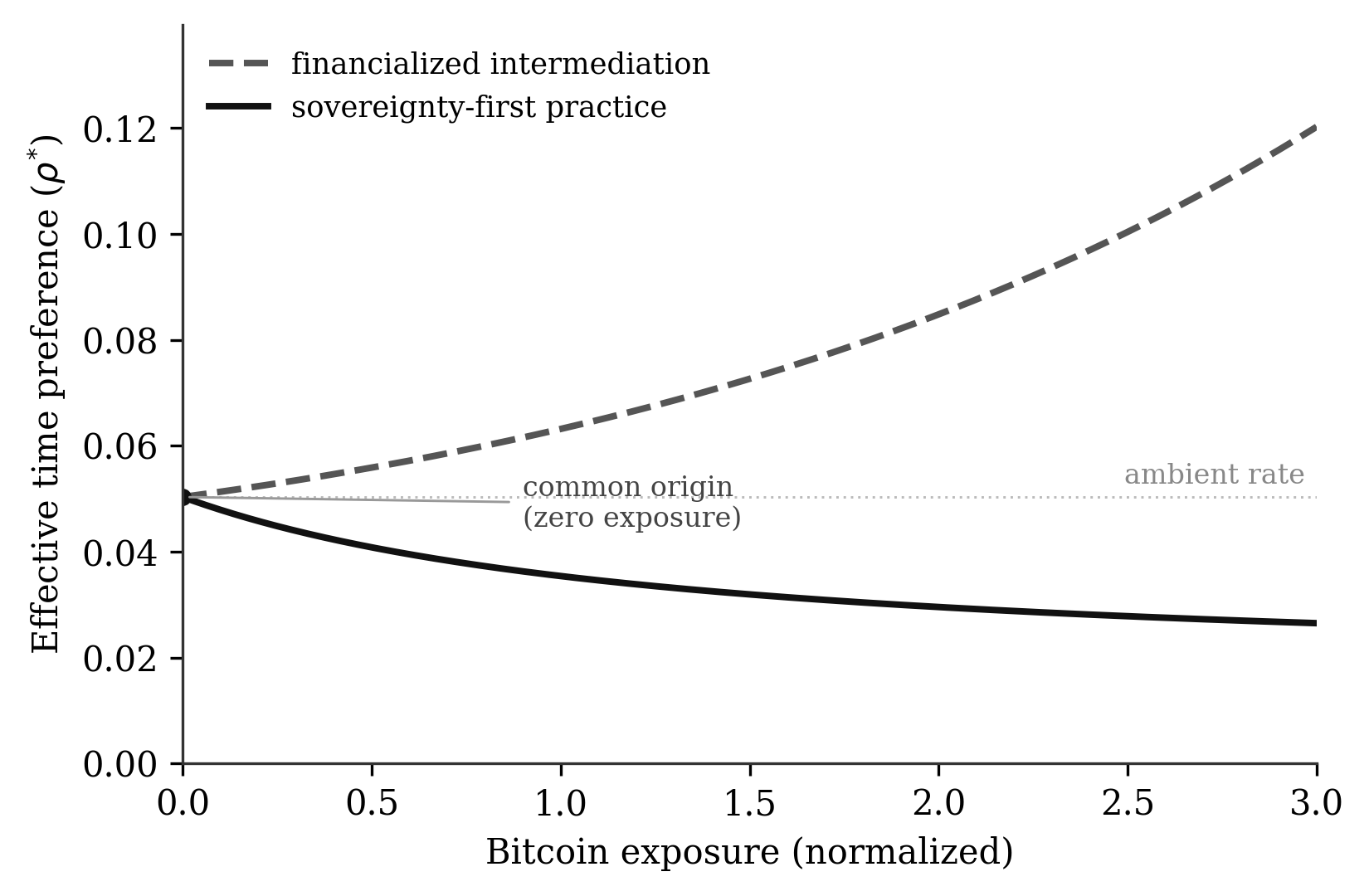
Figure 7.4. Effective time preference (ρ*) as a function of Bitcoin exposure under two governance regimes sharing a common origin at zero exposure: sovereignty-first practice, where holdings build the commitment anchor, and financialized intermediation, where the same holdings raise turnover instead. Identical exposure moves effective time preference in opposite directions depending on the regime. The curves are schematic, with parameter values chosen to display qualitative structure rather than estimate magnitudes.
The divergence carries an implication that Bitcoin’s institutional narrative rarely draws. Financialization does not only weaken the temporal-anchor property; beyond the ambient rate it reverses it, turning an asset that lowers effective time preference into one that raises it. In welfare economics terminology, it changes a positive externality into a negative externality.
Market development and temporal function can thus move in opposite directions at once since the inflows, products, and leverage that deepen liquidity and confer policy legitimacy are the same channels that raise turnover and let salience lapse. Price appreciation and the erosion of the property that motivated long-horizon holding are not in tension on this branch; they are one movement. My claim at this point is conditional rather than categorical: liquidity depth and policy clarity provide genuine benefits as structural variables (Chapter 8) and the current schematic model fixes no magnitude. It does, however, locate the tension in the governance form through which adoption occurs.
Separating the two readings is an identification problem and the conditionality shapes the test. Because the treatment channel operates only on the sovereignty-first branch, a credible design must distinguish governance regimes rather than exposure alone, comparing self-custody users with intermediated holders, following adopters over time, and asking whether effective time preference declines with the duration and depth of self-custody practice or stays flat once baseline impatience is controlled for. The treatment and selection channels diverge under these conditions, which makes the question empirically tractable.
Rigidity in two directions
The resistance to revision cuts in both directions for Bitcoin governance. Resistance to discretionary monetary revision preserves the reference point that lets Bitcoin function as a commitment device; resistance to every operational or implementation change becomes a different temporal failure when external conditions create risks the existing arrangement cannot absorb. The design problem is to preserve the commitments that give Bitcoin temporal depth while maintaining pathways for justified adaptation. Bitcoin remains one commitment device rather than a substitute for institutional judgment and its future durability is a separate question. It makes visible a form of temporal infrastructure increasingly scarce elsewhere: a public, contestable, and difficult-to-revise reference point around which long-horizon expectations can organize.
Conclusion
Time preference is both a psychological parameter revealed inside markets and an institutional outcome shaped by the informational conditions under which actors remember the past, attend to the present, and deliberate about possible futures. Informational turnover can therefore raise effective time preference without any change in underlying impatience, shortening the usable past through memory decay, reducing sustained engagement through attention compression, and multiplying future states faster than volitional judgment can evaluate them.
Bitcoin supplies a contemporary example of institutional temporal structure. Its fixed issuance schedule, resistance to discretionary revision, recurring halving rhythm, validation practices, and self-custody boundary supply reference points that are unusual in high-turnover environments. Those properties neither make Bitcoin a universal remedy for temporal compression nor settle the monetary claims made on its behalf; they show how a protocol can function as a commitment device when other reference points are unstable, and how the governance form through which it is held can invert that function, so that financialized intermediation raises the time preferences revealed around Bitcoin even when protocol rules remain intact.
The governance consequence is not a general preference for rigidity. Rigid institutions can preserve temporal scaffolding but can also prevent necessary adaptation. A particular form of resistance can preserve the reference points that long-horizon judgment requires or protect arrangements whose justification has expired. Temporal governance is not a choice between speed and slowness but a problem of fitting operational, implementation, political, and epistemic processes to the time horizons of the decisions they must govern.
Bitcoin is a rare contemporary institution whose temporal properties are public, technically specified, and socially contested at once. Whether those properties operate as designed depends on the governance form through which Bitcoin is held, not on the protocol, which is the book's mismatch problem seen from the side of a capability rather than a failure. Temporal infrastructure cannot be reduced to computation: the protocol can make some future conditions unusually legible but interpretation, salience, and legitimate adaptation still depend on institutions that connect operational rules to implementation practice, political authority, and epistemic commitments. Fast systems remain governable only when they stay coupled to slower forms of judgment.
Appendix A. Bitcoin time preference model
The model I use in this chapter – a simplified subset of my broader model used for institutional anchoring (https://github.com/murrayrudd/anchor-framework-simulator) – formalizes one claim: effective time preference is conditioned by an institutional-temporal environment whose durable reference points can be supplied, and eroded, through distinct channels. Relative to the general framework, this specification collapses the three anchor stocks to the single institutional anchor relevant here, bounds the existence channel from below, and floors the salience channel at unity. It distinguishes the existence of a commitment device from its salience in practice and specifies the conditions under which adoption would lower revealed time preference rather than select for actors who already hold long horizons.
Effective time preference
Let ρ0 > 0 be an actor’s baseline psychological rate, set by the determinants behavioral research documents. Effective time preference ρ* is the baseline scaled by two institutional channels:
ρ* = ρ0 · φE(A) · φZ(v, D) (A1)
where A ≥ 0 is the stock of commitment-device capacity available in the actor’s environment, v ≥ 0 is informational turnover (Chapter 2), and D ≥ 0 is the maintenance capacity that keeps the anchor salient – validation practice, self-custody discipline, and institutional memory.
Existence channel
φE captures the level of anchor stock available. More commitment-device capacity supplies more temporal scaffolding and lowers effective time preference, with diminishing returns:
φE(A) = 1 − (1 − φmin) · A / (kE + A), 0 < φmin ≤ 1 (A2)
so φE(0) = 1 (no anchor, no reduction), φE is decreasing and convex in A – each additional unit of anchor stock lowers ρ* by less – and φE → φmin as A → ∞. Bitcoin contributes to A when held under sovereignty-first practice.
Salience channel
φZ captures whether the anchor is actively practiced against a turning-over background. It rises with turnover and falls with maintenance capacity:
φZ(v, D) = 1 + (v / (v0 + D))θ, θ > 1 (A3)
so φZ = 1 when turnover is negligible and inflates convexly once turnover outpaces the capacity to keep the anchor salient. The convexity (θ > 1) is the formal content of the threshold result: the horizon compresses slowly under moderate turnover and rapidly once turnover crosses the maintenance capacity.
Laws of motion
The two stocks evolve under investment and informational-turnover-driven depreciation:
dA/dt = σA(I, D) − δA(v) · A, δA increasing and convex in v, σA increasing and concave in D (A4)
dD/dt = σD(m) − δD · D, σD concave in maintenance effort m (A5)
Here I is investment in commitment-device capacity (adoption, custody infrastructure, community norms) and m is maintenance effort. Maintenance capacity supports both channels, sustaining anchor supply through σA and keeping the anchor salient in φZ, as in the general framework. Convex depreciation δA(v) makes anchor loss accelerate as financialization raises turnover; concave supply σD(m) makes each additional unit of capacity progressively costlier in effort. Steady states are A* = σA(I, D) / δA(v) and D* = σD(m) / δD, which substitute into (A1).
Comparative statics
Four results follow. First, ∂ρ*/∂v > 0 and convex: rising informational turnover raises effective time preference, and the rise accelerates past a threshold because δA(v) shrinks A* while φZ inflates. Second, ∂ρ*/∂I < 0: investment in commitment-device capacity lowers effective time preference through the existence channel (Figure 7.1). Third, the offset condition: holding ρ* at its low-turnover baseline requires maintenance effort m that rises convexly with turnover, because maintenance must counter the salience channel and, through σA, the erosion of the anchor stock while capacity is supplied with diminishing returns; against any finite bound on attainable effort there is a critical turnover v* beyond which no feasible m restores the baseline, so compensation has a limit (Figure 7.2). Fourth, asymmetric recovery: erosion during a shock is governed by the high-turnover depreciation rate and rebuilding afterward by the low ambient rate, and because δA(v) is convex the two rates differ by an order of magnitude at the illustrated values, so a shock that erodes A recovers slowly even after turnover falls (Figure 7.3) – a rate asymmetry toward a unique steady state rather than bistability – producing hysteresis of the kind directional institutional latency describes (Chapter 6).
The Bitcoin conditionality
Bitcoin enters A only under sovereignty-first practice. Under financialized intermediation the same nominal holdings raise v, through mark-to-market discipline and derivative and margin turnover, while the maintenance capacity D lapses as custody and validation are delegated. In that regime Bitcoin’s contribution to φE falls toward zero while φZ inflates, so the asset becomes a source of turnover rather than an anchor. This reproduces the sovereignty-first and stability-first cleavage as a parameter regime rather than a stipulated distinction.
Regime reversal
Let exposure b index Bitcoin holdings, with a governance regime mapping b to the anchor stock A, the maintenance capacity D, and turnover v. Effective time preference along a regime is ρ*(b) = ρ0φE(A(b)) φZ(v(b), D(b)), with slope
dρ*/db = ρ0[φE′A′φZ + φE(φZvv′ + φZDD′)] (A6)
where φE′ < 0, φZv > 0, and φZD < 0. Under sovereignty-first practice A′ > 0, v′ = 0, and D′ ≥ 0, so both bracketed terms are non-positive and dρ*/db < 0. Under financialized intermediation A′ = 0, v′ > 0, and D′ < 0, so the salience term is positive and dρ*/db > 0. The regimes share the origin ρ*(0) = ρambient, the effective rate with no Bitcoin exposure; because their slopes carry opposite signs, the sovereignty-first branch lies below ρambient and the financialized branch above it for all b > 0. Financialization does not attenuate the anchor property but reverses its sign relative to holding no Bitcoin, and the reversal is a property of the governance regime rather than of the holdings. The result is robust to a positive anchor contribution under intermediation: because the existence channel is bounded below by φmin while the salience channel grows without bound in turnover, effective time preference crosses ρambient at a finite threshold exposure b* > 0 for any A′ > 0, with small contributions placing the threshold near zero and larger ones deferring it, sometimes after an interim dip below the ambient rate.
Identification
The adoption question is whether observed low time preference among holders is a treatment effect (adoption raises A and D, lowering ρ*) or a selection effect (low-ρ0 actors invest more in A). The model separates them through testable predictions. The treatment channel implies ρ* declines with the duration and depth of self-custody practice within holders and is moderated by the turnover regime v. The selection channel implies ρ* is flat in practice depth once ρ0 is controlled for. Panel variation in custody practice, turnover regime, and halving-cycle timing provides the discriminating variation.
References
Allen, DWE, C Berg, B Markey-Towler, et al. 2020. Blockchain and the evolution of institutional technologies: implications for innovation policy. Research Policy 49: 103865. https://doi.org/10.1016/j.respol.2019.103865
Bakshy, E, S Messing and LA Adamic 2015. Exposure to ideologically diverse news and opinion on Facebook. Science 348: 1130-1132. https://www.science.org/doi/abs/10.1126/science.aaa1160
Bernanke, BS 2023. 21st Century Monetary Policy. New York: W. W. Norton & Company.
Bier, J 2021. The Blocksize War: The Battle Over Who Controls Bitcoin’s Protocol Rules: Independently published.
Bradford, D, C Courtemanche, G Heutel, et al. 2017. Time preferences and consumer behavior. Journal of Risk and Uncertainty 55: 119-145. https://doi.org/10.1007/s11166-018-9272-8
Bromley, DW 2006. Sufficient Reason: Volitional Pragmatism and the Meaning of Economic Institutions. Princeton NJ: Princeton University Press.
Carr, N 2020. The Shallows: What the Internet Is Doing to Our Brains, Second Edition. New York: W. W. Norton & Company.
Catalini, C and JS Gans 2020. Some simple economics of the blockchain. Communications of the ACM 63: 80-90. https://doi.org/10.1145/3359552
Chaboud, AP, B Chiquoine, E Hjalmarsson, et al. 2014. Rise of the machines: algorithmic trading in the foreign exchange market. The Journal of Finance 69: 2045-2084. https://doi.org/10.1111/jofi.12186
Ciampaglia, GL, A Flammini and F Menczer 2015. The production of information in the attention economy. Scientific Reports 5: 9452. https://doi.org/10.1038/srep09452
Cohen, J, KM Ericson, D Laibson, et al. 2020. Measuring time preferences. Journal of Economic Literature 58: 299-347. https://doi.org/10.1257/jel.20191074
Dąbrowski, P 2022. Stock indices breakdown during the pandemic as the most dynamic bear market in history: Consequences for individual investors. Risks 10: 1. https://doi.org/10.3390/risks10010001
De Filippi, P, M Mannan and W Reijers 2020. Blockchain as a confidence machine: the problem of trust & challenges of governance. Technology in Society 62: 101284. https://doi.org/10.1016/j.techsoc.2020.101284
Dell’Acqua, F, E McFowland, E Mollick, et al. 2026. Navigating the jagged technological frontier: field experimental evidence of the effects of Artificial Intelligence on knowledge worker productivity and quality. Organization Science 37: 403-423. https://doi.org/10.1287/orsc.2025.21838
Eichengreen, B 1992. Golden Fetters: The Gold Standard and the Great Depression, 1919–1939. Oxford, UK: Oxford University Press.
Eichengreen, B 2019. Globalizing Capital: A History of the International Monetary System, Third Edition. Princeton, NJ: Princeton University Press.
Elster, J 2000. Ulysses Unbound: Studies in Rationality, Precommitment, and Constraints. Cambridge: Cambridge University Press.
Frederick, S, G Loewenstein and T O'Donoghue 2002. Time discounting and time preference: a critical review. Journal of Economic Literature 40: 351-401. https://doi.org/10.1257/002205102320161311
Gans, JS and H Halaburda 2023. "Zero cost'' majority attacks on permissionless blockchains. NBER Working Paper 31473, http://www.nber.org/papers/w31473
GESDA 2026. GESDA Science Breakthrough Radar 2026. Geneva Coalition on Anticipatory Science and Diplomacy annual report, https://www.gesda.global/gesda-science-breakthrough-radar/
Gillespie, T 2014. The relevance of algorithms. In Media Technologies: Essays on Communication, Materiality, and Society, eds. T Gillespie, PJ Boczkowski and KA Foot, 167-193. Cambridge, MA: The MIT Press. https://doi.org/10.7551/mitpress/9042.003.0013
Godin, B 2010. Innovation without the word: William F. Ogburn’s contribution to the study of technological innovation. Minerva 48: 277-307. https://doi.org/10.1007/s11024-010-9151-1
Greif, A 2006. Institutions and the Path to the Modern Economy: Lessons from Medieval Trade. Cambridge, UK: Cambridge University Press.
Hendershott, T, CM Jones and AJ Menkveld 2011. Does algorithmic trading improve liquidity? The Journal of Finance 66: 1-33. https://doi.org/10.1111/j.1540-6261.2010.01624.x
Heymann, D and A Leijonhufvud 1995. High Inflation: The Arne Ryde Memorial Lectures. Oxford: Clarendon Press.
Höchtl, J, P Parycek and R Schöllhammer 2016. Big data in the policy cycle: policy decision making in the digital era. Journal of Organizational Computing and Electronic Commerce 26: 147-169. https://doi.org/10.1080/10919392.2015.1125187
Hodgson, GM 1998. The approach of institutional economics. Journal of Economic Literature 36: 166-192. http://www.jstor.org/stable/2564954
Hodgson, GM 2004. Reclaiming habit for institutional economics. Journal of Economic Psychology 25: 651-660.
Jadhav, A and V Mirza 2025. Large Language Models in equity markets: applications, techniques, and insights. Frontiers in Artificial Intelligence 8: 1608365. https://doi.org/10.3389/frai.2025.1608365
Johann, D, J Neufeld, K Thomas, et al. 2024. The impact of researchers’ perceived pressure on their publication strategies. Research Evaluation. https://doi.org/10.1093/reseval/rvae011
Jumper, J, R Evans, A Pritzel, et al. 2021. Highly accurate protein structure prediction with AlphaFold. Nature 596: 583-589. https://doi.org/10.1038/s41586-021-03819-2
Just, N and M Latzer 2017. Governance by algorithms: reality construction by algorithmic selection on the Internet. Media, Culture and Society 39: 238-258. https://doi.org/10.1080/08838151.2020.1843357
Kindleberger, CP and RZ Aliber 2005. Manias, Panics and Crashes: A History of Financial Crises. Fifth Edition. London: Palgrave Macmillan.
Laibson, D 1998. Life-cycle consumption and hyperbolic discount functions. European Economic Review 42: 861-871. https://doi.org/10.1016/S0014-2921(97)00132-3
Liang, S and Y Zhang 2025. Generative recommendation: a survey of models, systems, and industrial advances. TechRxiv 2025. https://doi.org/10.36227/techrxiv.176523089.94266134/v2
Lorenz-Spreen, P, BM Mønsted, P Hövel, et al. 2019. Accelerating dynamics of collective attention. Nature Communications 10: 1759. https://doi.org/10.1038/s41467-019-09311-w
Malmendier, U and S Nagel 2011. Depression babies: do macroeconomic experiences affect risk taking?*. The Quarterly Journal of Economics 126: 373-416. https://doi.org/10.1093/qje/qjq004
Marchant, GE, BR Allenby and JR Herkert (eds). 2011. The Growing Gap Between Emerging Technologies and Legal-Ethical Oversight: The Pacing Problem. Dordrecht: Springer
Meier, S and C Sprenger 2010. Present-biased preferences and credit card borrowing. American Economic Journal: Applied Economics 2: 193–210. https://doi.org/10.1257/app.2.1.193
Millo, Y and D MacKenzie 2008. The usefulness of inaccurate models: the emergence of financial risk management Centre for Analysis of Risk and Regulation (CARR) Discussion Papers Series, available at SSRN, http://dx.doi.org/10.2139/ssrn.1115883
Nakamoto, S 2008. Bitcoin: a peer-to-peer electronic cash system. Unpublished white paper, https://bitcoin.org/bitcoin.pdf
North, DC 1990. Institutions, Institutional Change and Economic Performance. Cambridge MA: Cambridge University Press.
Noy, S and W Zhang 2023. Experimental evidence on the productivity effects of generative artificial intelligence. Science 381: 187-192. https://doi.org/10.1126/science.adh2586
Ostrom, V 1997. The Meaning of Democracy and the Vulnerability of Democracies: A Response to Tocqueville's Challenge. Ann Arbor: University of Michigan Press.
Pariser, E 2011. The Filter Bubble: What the Internet Is Hiding from You. London: Penguin Books.
Pasquale, F 2015. The Black Box Society: The Secret Algorithms That Control Money and Information. Cambridge MA: Harvard University Press.
Pauly, D 1995. Anecdotes and the shifting baseline syndrome of fisheries. Trends in Ecology and Evolution 10: 430. https://doi.org/10.1016/s0169-5347(00)89171-5
Rao, A, B Lucey and S Kumar 2025. Financial market reactions to U.S. tariff announcements: evidence from trade-surplus and trade-deficit countries. Finance Research Letters 81: 107465. https://doi.org/10.1016/j.frl.2025.107465
Ricci, F, L Rokach and B Shapira (eds). 2022. Recommender Systems: Techniques, Applications, and Challenges. New York, NY: Springer US.
Rieger, MO, M Wang and T Hens 2021. Universal time preference. PLoS ONE 16: e0245692. https://doi.org/10.1371/journal.pone.0245692
Roberts, ST 2019. Behind the Screen: Content Moderation in the Shadows of Social Media. New Haven, CT: Yale University Press.
Romer, PM 1990. Endogenous technological change. Journal of Political Economy 98: S71-S102. http://www.jstor.org/stable/2937632
Rudd, MA 2000. Live long and prosper: collective action, social capital and social vision. Ecological Economics 34: 131-144. https://doi.org/10.1016/S0921-8009(00)00152-X
Rudd, MA 2023. Bitcoin is full of surprises. Challenges 14: 27. https://doi.org/10.3390/challe14020027
Rudd, MA 2025. Important Bitcoin information gaps and research needs for 2024. SSRN preprint, https://dx.doi.org/10.2139/ssrn.5146515
Rudd, MA 2026. Keeping the future visible: institutional anchors and time preference in ecosystem service appraisal. Manuscript in review,
Scheibehenne, B, R Greifeneder and PM Todd 2010. Can there ever be too many options? A meta-analytic review of choice overload. Journal of Consumer Research 37: 409-425. https://doi.org/10.1086/651235
Searle, JR 2005. What is an institution? Journal of Institutional Economics 1: 1-22. https://doi.org/10.1017/S1744137405000020
Selgin, G 2015. Synthetic commodity money. Journal of Financial Stability 17: 92-99. https://doi.org/10.1016/j.jfs.2014.07.002
Sen, A 1999. Development as Freedom. Oxford, UK: Oxford University Press.
Simon, H 1971. Designing organizations for an information rich world. In Computers, Communications and the Public Interest, ed. M Greenberger, 37-52. Baltimore: Johns Hopkins University Press.
Sunstein, CR 2005. Irreversible and catastrophic. AEI-Brookings Joint Center Working Paper No. 05-04, Harvard Public Law Working Paper, http://dx.doi.org/10.2139/ssrn.707128
Tversky, A and D Kahneman 1973. Availability: a heuristic for judging frequency and probability. Cognitive Psychology 5: 207-232. https://doi.org/10.1016/0010-0285(73)90033-9
Usher, N 2014. Making News at The New York Times. Ann Arbor, MI: University of Michigan Press.
Veblen, T 1992 [1899]. The Theory of the Leisure Class. New York: Routledge.
Veldkamp, LL 2011. Information Choice in Macroeconomics and Finance. Princeton, NJ: Princeton University Press.
Vosoughi, S, D Roy and S Aral 2018. The spread of true and false news online. Science 359: 1146-1151. https://doi.org/10.1126/science.aap9559
Walsh, JP and GR Ungson 1991. Organizational memory. The Academy of Management Review 16: 57-91. https://doi.org/10.2307/258607
Weitzman, ML 2009. On modeling and interpreting the economics of catastrophic climate change. Review of Economics and Statistics 91: 1-19. https://doi.org/10.1162/rest.91.1.1
Weller, BM 2018. Does algorithmic trading reduce information acquisition? The Review of Financial Studies 31: 2184-2226. https://doi.org/10.1093/rfs/hhx137
Williamson, OE 1985. The Economic Institutions of Capitalism. New York: The Free Press.
Williamson, OE 1999. Public and private bureaucracies: a transaction cost economics perspective. Journal of Law, Economics and Organization 15: 306-341. https://doi.org/10.1093/jleo/15.1.306
Wu, F and BA Huberman 2007. Novelty and collective attention. Proceedings of the National Academy of Sciences 104: 17599-17601. https://doi.org/10.1073/pnas.0704916104
Zenil, H, J Tegnér, FS Abrahão, et al. 2026. The future of fundamental science led by generative closed-loop artificial intelligence. Frontiers in Artificial Intelligence 9. https://doi.org/10.3389/frai.2026.1678539
Zuboff, S 2019. The Age of Surveillance Capitalism: The Fight for a Human Future at the New Frontier of Power. New York: PublicAffairs.


Comments ()