FIR research
Bitcoin Treasury Credit: Financing Flexibility and Investor Risk
Explore how Bitcoin treasury preferred equity changes financing flexibility, investor risk, trading liquidity, and institutional adoption.
Summary
Jeff Walton argues on the October 21, 2026, True North episode that perpetual preferred equity can give Bitcoin treasury companies greater financing flexibility. His framework combines the removal of scheduled principal repayment with security design that separates investor preferences by seniority and dividend structure. The resulting tradeoff concerns how companies preserve control over volatile assets while allocating continuing payment obligations and downside exposure among investors.
Take-Home Messages
- Financing comparison: Walton’s cash-outflow examples make maturity timing relevant but leave the full valuation of continuing preferred obligations unresolved.
- Risk allocation: Walton presents reduced liquidation pressure on common shareholders as a benefit that comes with weaker intervention rights for preferred investors.
- Market liquidity: Daily dividends may attract additional trading, but Walton acknowledges that issuance growth accompanied the volume increase he reports.
- Balance-sheet assurance: Walton’s acknowledgment that reserve proofs omit liabilities makes asset visibility only one component of investor assessment.
- Institutional access: Ratings, capital treatment, and liability matching remain adoption constraints in Walton’s account of insurance demand.
Overview
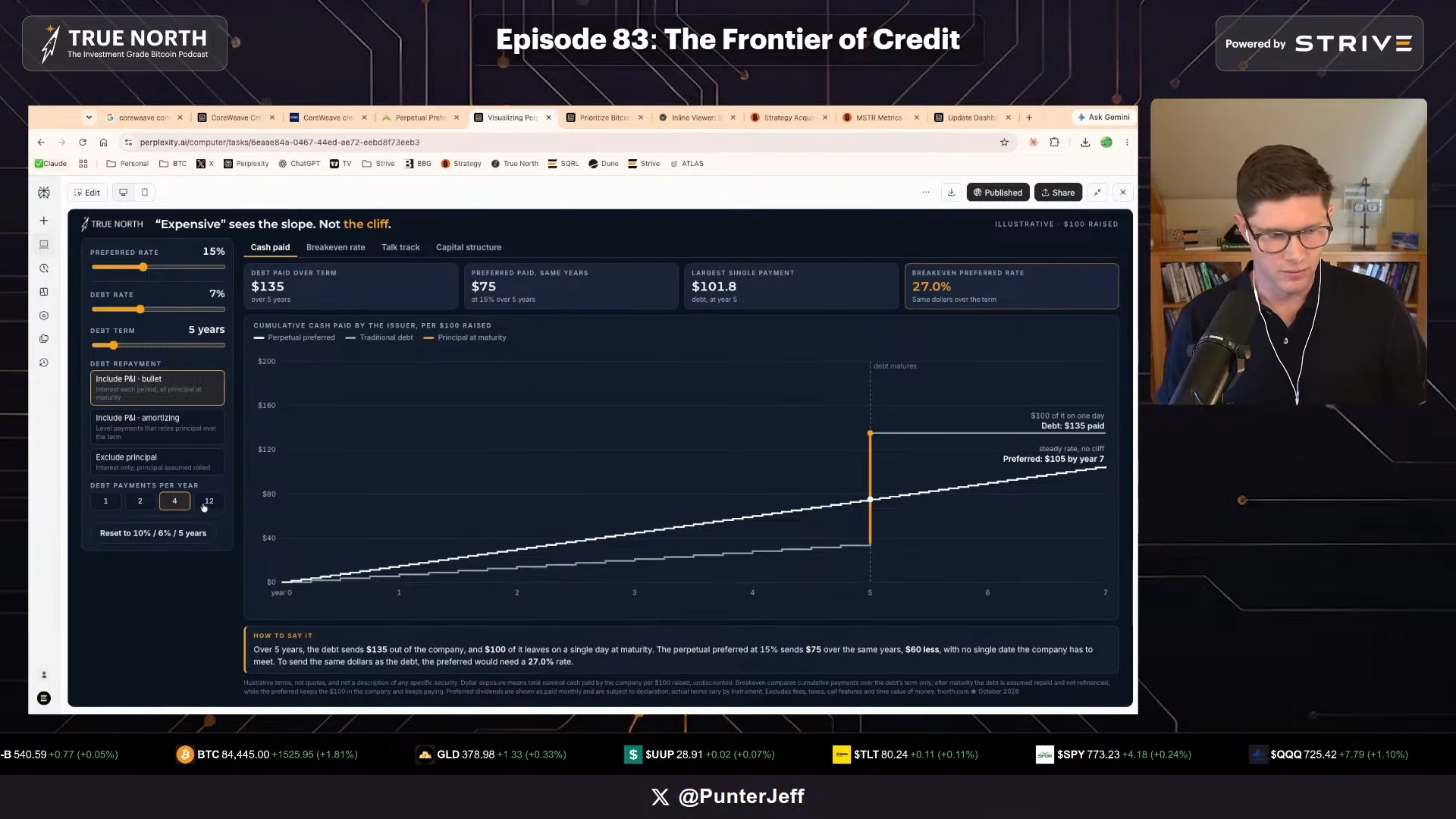
For Bitcoin treasury companies, Jeff Walton favors perpetual preferred equity because it removes the scheduled principal repayment associated with term debt. He illustrates the distinction by comparing a 15% preferred payout with 7% debt carrying a five-year maturity, emphasizing the debt’s terminal cash requirement. His examples establish the importance of payment timing within his framework, while leaving the value of continuing preferred claims beyond the comparison horizon unresolved.
Strive’s security design separates a senior variable-rate instrument, SATA, from a junior fixed-rate instrument, SATS, according to Walton. He describes SATS as cumulative, with a fixed annual payment of $15 per share, and places it above common stock in the capital structure. He expects this combination to reach different investors and broaden issuance opportunities when the senior instrument trades below its issuance threshold.
Walton argues that daily dividends can attract traders who evaluate the next payment rather than commit to long holding periods. He reports higher SATA trading volume after daily payments began, acknowledges simultaneous issuance growth, and expects trading between SATA and SATS to generate useful relative-yield information. His proposed mechanism connects payment design to liquidity and financing decisions, although he does not isolate its causal effect.
Walton’s argument for Bitcoin as capital rests partly on the possibility of observing the underlying assets. He connects that view to his account of alleged fraudulent reinsurance collateral, then acknowledges that proof of reserves cannot reveal the liabilities against those assets. This tension makes the relationship between technical verification and conventional financial disclosure central to his account of investor trust.
Implications and Future Outlook
Issuers considering Walton’s financing approach face a choice between scheduled repayment pressure and continuing dividend commitments (see my recent Strategy papers for more on this). He also argues that convertible financing can become expensive through dilution when common equity appreciates, making the preferred alternative sensitive to growth assumptions. The unresolved decision concerns which structure preserves financing capacity across both favorable markets and sustained weakness.
Management teams adopting the market monitoring approach Walton describes must interpret preferred prices alongside cash reserves and issuance capacity. His account of Strategy’s repurchases illustrates the use of cash to support a security’s return toward par, while his amplification comments connect financing choices to Bitcoin price movements. The resulting allocation problem requires a choice among retaining liquidity, retiring claims, and acquiring additional Bitcoin.
Institutions evaluating these securities face constraints that extend beyond the advertised dividend. Walton identifies ratings and capital treatment as barriers for insurers and separately emphasizes their need to match asset cash flows with liabilities. Wider adoption therefore remains contingent, in his account, on resolving both credit-assessment requirements and the mismatch between perpetual instruments and institutional funding needs.
Some Key Information Gaps
- How should issuers compare the full economic cost of perpetual preferred equity and term debt while accounting for continuing dividends, principal repayment, and refinancing risk? A consistent comparison would support financing decisions that account for both liquidity demands and continuing claims.
- How do differences in liquidation rights and dividend-deferral provisions redistribute losses among preferred holders and common shareholders during sustained distress? Evidence on this allocation would inform investor protection and the design of financial claims.
- Does daily dividend payment improve market liquidity after controlling for issuance growth, market conditions, and changes in investor composition? Establishing the effect would help issuers and market designers evaluate whether payment frequency creates durable trading benefits.
- What combination of reserve verification, liability disclosure, and custody assurance best supports investor assessment of a Bitcoin treasury balance sheet? The answer would guide disclosure systems that connect observable assets to enforceable financial claims.
- Which rating, capital-treatment, and duration constraints most limit insurance-company demand for Bitcoin treasury preferred securities? Identifying the binding constraints would focus institutional research and product development on the barriers that actually restrict adoption.
Broader Implications
Contractual flexibility reallocates governance power
One broader inference is that financing innovation can change who controls decisions during distress as much as it changes payment schedules. Removing a creditor’s intervention mechanism may give management more time while leaving investors more dependent on management’s judgment. Evaluating such arrangements therefore requires attention to decision rights alongside expected returns.
Trading frequency and funding resilience can diverge
A second inference is that more frequent income payments could expand trading activity without establishing that financing will remain available under stress. Short holding periods may increase normal-market participation while leaving longer-term asset and payment risks unresolved. Market design should therefore distinguish transaction activity from the capacity to absorb persistent selling pressure.
Verifiable assets require interpretable claims
A third inference is that a transparent asset ledger can improve one layer of financial assurance without settling ownership, encumbrance, or liability questions. Institutions may need systems that connect technical evidence of assets with the contractual claims against them. Such integration could shift trust toward combined verification processes rather than a choice between public ledgers and conventional reporting.
Institutional fit shapes financial diffusion
A fourth inference is that a security’s adoption can depend on institutional mandates as much as on its promised cash payments. Instruments that fit an issuer’s preferred funding horizon may fit poorly with an investor’s liability schedule or capital framework. Financial innovation therefore creates a coordination problem across product designers, investors, and assessment institutions.